Expertise · October 18, 2026
4 Manufacturing PR Campaigns That Earned Real Coverage
By Kyle Porter, Executive Vice President & Managing Director.
Updated October 21, 2026
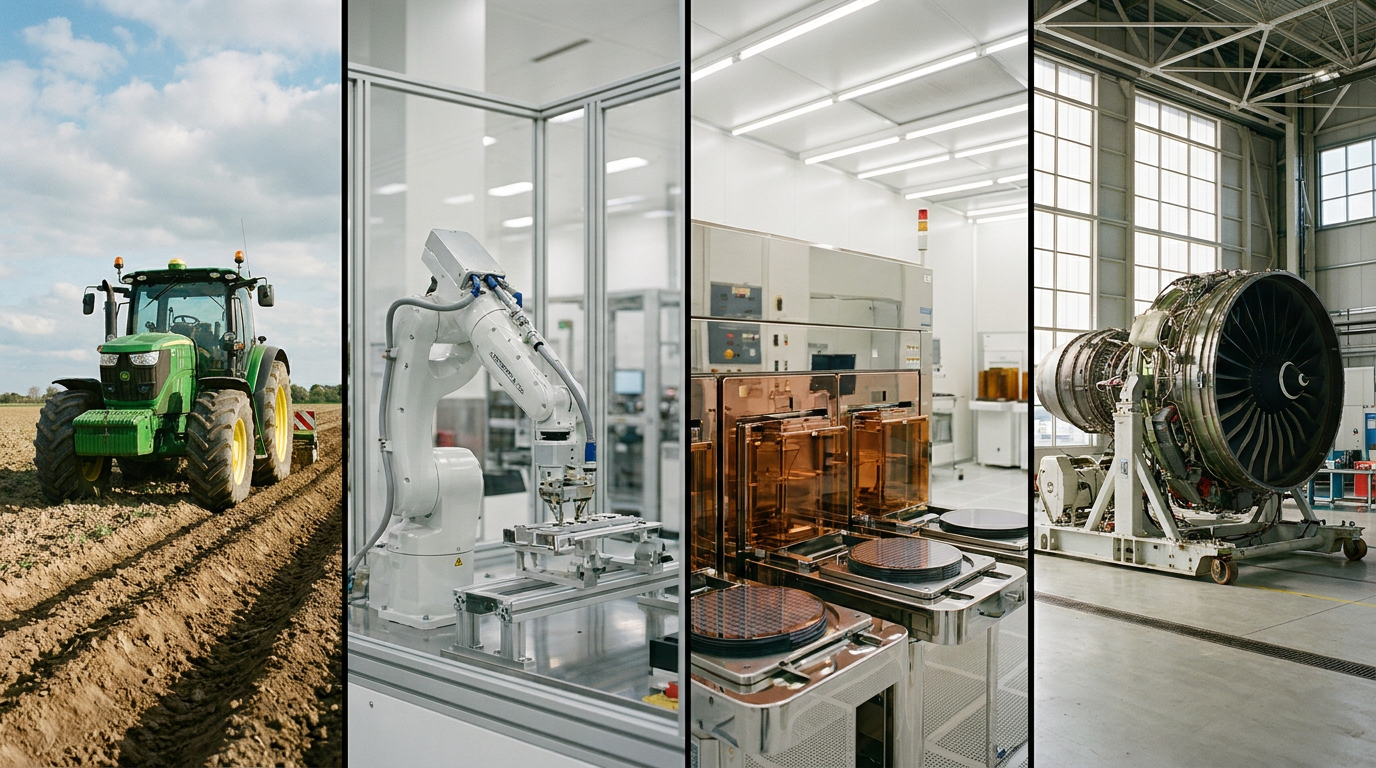
Manufacturing PR campaigns earn coverage when they pair a physical thing with a number a reporter can check. John Deere showed a driverless tractor at CES, Apple attached a $500 billion figure to a Houston factory, TSMC held a tool-in ceremony with a president and three chip CEOs, and Rolls-Royce submitted an electric aircraft speed claim for independent verification. Each move below names its mechanism and what a factory brand can copy.
Updated October 18, 2026.
None of the sources below say a PR team planned these four moves, so treat them as repeatable mechanisms, not agency case studies. A manufacturer with none of these assets has only announcements to pitch.
How were these four manufacturing PR campaigns chosen?
Virgo chose four manufacturing PR campaigns that a company release or a major outlet documents, that carry a figure a reporter can check, and that name a spokesperson or institution. Moves supported only by social posts or unnamed sources were left out, because an editor cannot verify them.
The selection is a judgment, not a ranking. Other manufacturers have earned coverage, and these four were picked because each one shows a different mechanism and each one has a document behind it. We started from a longer list and kept only the cases we could source.
How did John Deere launch an autonomous tractor at CES?
John Deere revealed a fully autonomous tractor at a CES 2022 press conference on January 4, 2022, and said it was ready for large-scale production. The machine combines Deere's 8R tractor with a TruSet-enabled chisel plow and a GPS guidance system, and it has six pairs of stereo cameras for 360-degree obstacle detection, according to Equipment World.
The coverage repeated the same specifics. Robotics 24/7 quoted Deere saying the tractor serves a specific purpose, feeding the world, and reported that it would be available to farmers later in 2022. SiliconANGLE described the geofence check that keeps the tractor where it is meant to be, and FarmingUK reported that position is accurate to within less than one inch and that farmers start the machine with a swipe in the Operations Center Mobile app.
Reports differed on availability. Electrek described the tractor as already running on select farms and available for sale, while the Deere statement quoted by Robotics 24/7 said it would reach farmers later in the year. A reader checking the status of a launch should rely on the company's own dated statement.
Why it works: In Virgo's read, a machine with a countable feature list (six camera pairs, a geofence, a swipe to start) gave reporters concrete details to repeat, and the CES stage turned an agricultural product into technology news.
Copy this: Pick the venue where your audience is not looking for you, show the finished product, and publish a feature list with numbers a trade editor can check.
How did Apple turn a manufacturing pledge into a news cycle?
Apple announced on February 24, 2025 that it planned to invest more than $500 billion in the United States over four years, including hiring 20,000 people and building a server factory in Texas, according to ABC13 Houston. The Houston facility was described as 250,000 square feet, due to open in 2026, and expected to create thousands of jobs.
Verdict reported that the package also doubled Apple's US advanced manufacturing fund, created in 2017, from $5 billion to $10 billion, and included an Apple Manufacturing Academy in Detroit offering free courses in project management and manufacturing process optimization.
Coverage also placed the pledge in context. The Associated Press, as carried by ABC13, noted that it came days after President Trump said Tim Cook had promised to shift manufacturing from Mexico to the United States, and that Apple had made a similar announcement in early 2018, promising 20,000 new jobs as part of a $350 billion spend.
Why it works: In Virgo's read, the large headline number gave the story reach, and the one concrete site, with a size, a year and a product, gave reporters something to describe. The earlier 2018 pledge shows the risk: a repeated number invites comparison with the last one.
Copy this: Pair any large investment figure with one named site, a size and an opening year, and expect reporters to compare it with your earlier announcements.
How did TSMC use a tool-in ceremony to anchor a $40 billion story?
TSMC used a ceremony marking the arrival of its first manufacturing equipment in Arizona to announce a second fab and a larger investment. On December 6, 2022, TSMC said the two Arizona fabs would represent roughly $40 billion in investment, the largest foreign direct investment in Arizona history, according to the TSMC press release.
The release gave countable figures: more than 10,000 construction workers on the site, 10,000 expected high-tech jobs including 4,500 direct TSMC jobs, and more than 600,000 wafers a year when both fabs are complete. It listed who presided, including President Biden, Commerce Secretary Gina Raimondo, Apple's Tim Cook, AMD's Lisa Su and Nvidia's Jensen Huang.
Euronews, carrying a Reuters report, noted that the investment more than tripled the planned figure for the plant, that Nvidia's Huang called it a game-changing development for the industry, and that TSMC's chairman estimated annual revenue of $10 billion once both plants are running.
Why it works: In Virgo's read, a ceremony tied to a physical milestone gave the news a date and a photograph, and putting customers on the stage turned a supplier announcement into an industry statement.
Copy this: Build the announcement around a physical milestone, invite customers to speak at it, and release the job, capacity and output figures in the same document.
How did Rolls-Royce stage an electric aircraft speed record?
Rolls-Royce told the press on November 19, 2021 that its all-electric Spirit of Innovation aircraft reached 555.9 km/h (345.4 mph) over three kilometers on November 16, beating the existing record by 213.04 km/h, and that it had submitted the data to the Fédération Aéronautique Internationale for verification, per its press release. The aircraft also reached a maximum speed of 623 km/h, which the company said it believed made it the world's fastest all-electric vehicle.
The wording mattered. The first release used the language of a claim, and a later January 20, 2022 release reported that two of the records had been independently confirmed, while the third, a climb to 3,000 meters in 202 seconds, was still going through verification. FLYER reported the run at the UK Ministry of Defence's Boscombe Down site.
Why it works: In Virgo's read, naming an outside certifying body and describing the result as a claim until confirmed made the story hard to attack, and the confirmation gave the company a second announcement.
Copy this: Submit a performance claim to a recognized third party, call it a claim until it is confirmed, and plan the confirmation as its own announcement.
What evidence backs each of the four campaigns?
Each of the four campaigns rests on a company release or a major outlet that names its figure. The list below shows the key figure, the evidence and the source type, so a reader can check each one.
-
John Deere (January 2022): six stereo camera pairs, geofence accurate within an inch, availability later in 2022. Evidence: Equipment World, Robotics 24/7 and SiliconANGLE coverage of the CES press conference. Source type: trade and technology reporting.
-
Apple (February 2025): more than $500 billion over four years, 20,000 hires, a 250,000 square foot Houston factory opening in 2026. Evidence: ABC13 carrying an Associated Press report, plus Verdict. Source type: wire and trade reporting.
-
TSMC (December 2022): about $40 billion, 4,500 direct jobs, more than 600,000 wafers a year. Evidence: TSMC press release and Euronews carrying Reuters. Source type: company release and wire reporting.
-
Rolls-Royce (November 2021): 555.9 km/h over three kilometers, two records confirmed in January 2022. Evidence: two Rolls-Royce releases and FLYER. Source type: company release and trade reporting.
In Virgo's read, the two company releases in this list, TSMC's and Rolls-Royce's, show the cheapest route for a manufacturer. A brand writes the release, names the method and states the figure, and the editor never has to be persuaded to attend a launch.
A claim without a document gives an editor nothing to verify. A capacity figure with no stated basis, for example, cannot be checked, so it rarely supports a news story on its own.
Which mechanism fits your manufacturing brand?
The four mechanisms differ in the asset a manufacturer must own before it can use them. The list below pairs each mechanism with that asset, based on Virgo's assessment of the four examples.
-
Deere, product reveal on a technology stage: a finished, demonstrable product and a feature list with numbers. Best fit: equipment makers with a real product.
-
Apple, investment pledge with one named site: a budget approved at executive level and a specific facility. Best fit: large manufacturers with reach.
-
TSMC, ceremony at a physical milestone: a construction or equipment milestone and customers willing to speak. Best fit: plant and fab announcements.
-
Rolls-Royce, verified performance claim: a measurable result and a certifying body. Best fit: engineering-led brands with a testable record.
What should a manufacturing brand do first?
A manufacturing brand should list the assets it already owns, such as a product, a milestone and a measurable result, and match each to the list above. Start with the milestone, because it gives the news a date and an image.
Then check the number. Choose the one figure you can document, write down the basis for it, and name the outside party that could confirm it. Pick the spokesperson who will explain it on the record.
For more on how plant news earns coverage, see our comparison of factory opening announcements from Hyundai, Toyota and Intel, and our look at industrial sustainability PR. The neighboring freight lane follows the same logic in our roundup of logistics PR campaigns. This post is part of Virgo's physical economy PR guide, which maps the patterns across 19 cases, and it feeds our upcoming manufacturing PR agency guide.
Frequently asked questions
What makes a manufacturing PR campaign earn coverage?
A physical product, milestone or measured result paired with a number a reporter can check. The four campaigns above each gave editors a figure and a named source behind it.
Do manufacturers need a big budget for this?
No. TSMC and Rolls-Royce both used their own press releases, and the mechanism was the milestone or the verified claim, not the spend. Smaller manufacturers can copy the structure with a smaller milestone.
Why did Rolls-Royce call its record a claim?
Records are confirmed by a certifying body. Calling the result a claim until confirmation kept the statement accurate and created a second announcement when two records were confirmed.
What is the risk of a large investment announcement?
Reporters compare it with earlier pledges. Coverage of Apple's 2025 announcement noted a similar 2018 pledge, so a repeated headline number needs a concrete site and timeline to hold up.
Where should a manufacturer announce a new product?
Where its audience is not looking for it. Deere used a technology show to launch farm equipment, which drew technology outlets as well as agriculture coverage.
Follow us