Expertise · October 21, 2026
Maritime PR Cases: 4 Shipping Communications Compared
By Kyle Porter, Executive Vice President & Managing Director.
Updated October 21, 2026
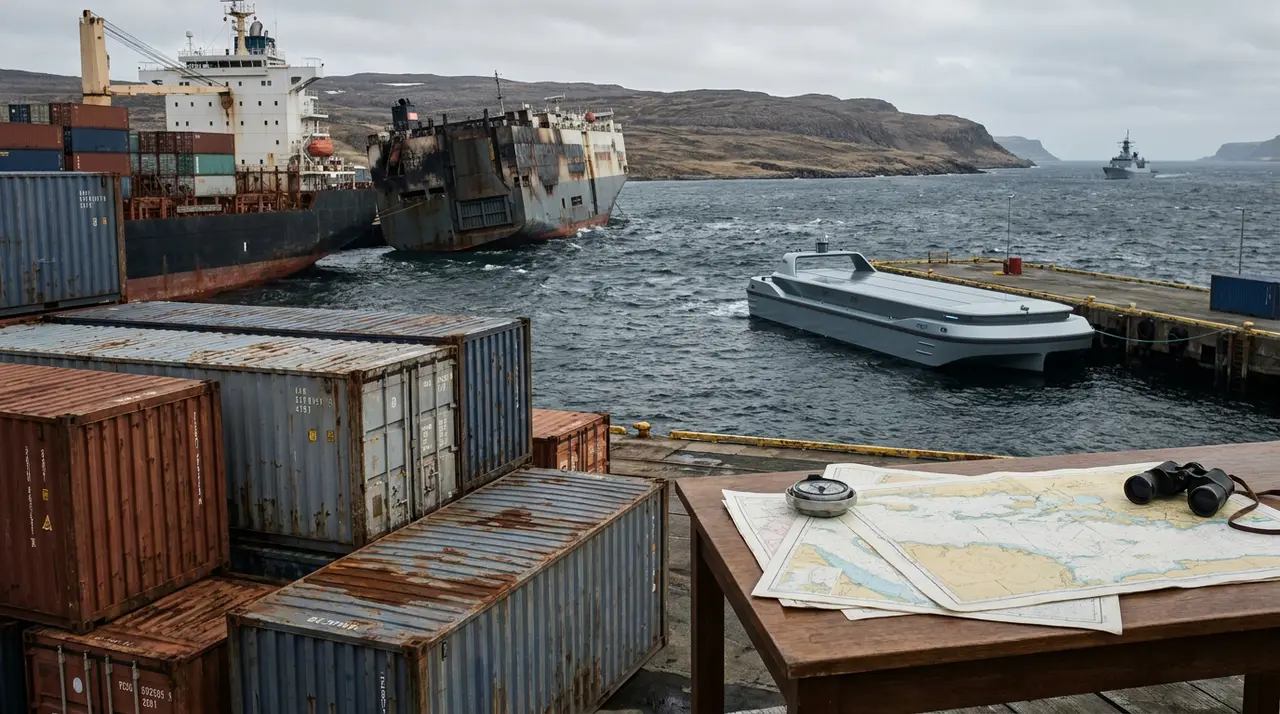
Maritime PR cases turn on which facts a company publishes in the first days. Four cases show the range: Hanjin Shipping left between 85 and 96 ships stranded while other parties supplied the numbers, Mitsui O.S.K. Lines opened a dedicated information site for the Felicity Ace fire, Hapag-Lloyd and Maersk set different pause terms for the Red Sea, and Yara framed its electric ship as replacing trucks.
The Hanjin collapse began with a court receivership filing on August 31, 2016. This Seatrade Maritime timeline of the collapse reported that Hanjin's 96 container ships were left stranded with about $14 billion of cargo aboard. The other three cases show how carriers and shippers handle that kind of uncertainty with more or less public detail.
What did the Hanjin collapse show about shipping communications?
In the coverage reviewed for this article, the public numbers on the Hanjin collapse came from consultancies, a government ministry and newspapers, and those numbers did not agree. Hanjin Shipping filed for court receivership on August 31, 2016, one day after creditor banks withdrew support, and Reuters reported that ports from China to Spain, the United States and Canada refused entry to its vessels. A Hanjin official in Busan confirmed to Reuters that its ships were not entering the port because container lashing providers denied service on concerns they would not be paid.
Lars Jensen, chief executive of the container shipping research firm Sea Intelligence Consulting, told NPR that the stranded fleet was some 85 to 90 vessels. Seatrade Maritime reported 96 container ships. South Korea's maritime ministry told Reuters that about 540,000 TEU of cargo was loaded on Hanjin vessels, and Seatrade Maritime put the value of cargo aboard at about $14 billion.
Customers and partners reacted within days. Reuters reported that LG Electronics was setting up contingency plans for cargo aboard Hanjin ships in case they were seized, and the Seatrade timeline shows that on September 2 Evergreen distanced itself from Hanjin as an alliance member and CMA CGM ended its partnership with Hanjin on five services.
The legal and financial steps came next. According to the same timeline, Hanjin received $90 million in emergency funding from its parent on September 6, and a US bankruptcy judge granted a protection order on September 10 that allowed its ships to dock at US ports without fear of arrest. By October 7, Hanjin vessels were berthing in Singapore, but shippers had to pay a deposit of SGD 5,000 to obtain their import containers.
A carrier or forwarder in a similar position gives shippers less reason to compile their own lists when it publishes one dated page with vessel names, port status and cargo release terms. That page also fixes the numbers, so a count of 85 and a count of 96 do not circulate side by side.
How did MOL communicate during the Felicity Ace fire?
Mitsui O.S.K. Lines (MOL), which manages the car carrier Felicity Ace, communicated the February 2022 fire through short operator statements and a dedicated information centre website. The ship caught fire on February 16, 2022, about 90 nautical miles southwest of the Azores, all 22 crew were evacuated, and the vessel sank on March 1, 2022, according to gCaptain's report on the litigation.
MOL's February 18 statement reported all crew safe in a hotel in the Azores and a salvage company appointed, according to Motor1. Bloomberg, in a report carried by gCaptain, said an internal email from Volkswagen's U.S. operations put the number of vehicles aboard at 3,965. Porsche spokesperson Luke Vandezande said about 1,100 Porsche vehicles were among them and that affected customers were being contacted by their dealers.
The cargo value was not stated consistently. Riviera Maritime Media gave Russell Group's estimate of the cargo as $400 million and as $438 million within the same report. On February 22, MOL said tugs were spraying water on the still-burning ship and that no oil leak had been reported, according to a Reuters report carried by the Inquirer.
The cause is still not publicly established four years later. gCaptain reported on May 29, 2026 that, according to the German legal news outlet LTO, the Regional Court of Stuttgart dismissed a lawsuit seeking about 30 million euros from Porsche. The vessel's Japanese owner and five marine hull insurers had alleged that a self-igniting lithium-ion battery in a Porsche Taycan started the fire, and the court found they had not proved that a Porsche vehicle was the source.
LTO reported that the ruling is not final and that a separate suit in Braunschweig seeking hundreds of millions of euros remains pending. gCaptain added that the Panama Maritime Authority submitted its investigation report to the International Maritime Organization in 2022, but the report has not been released publicly.
The early statements stuck to facts the operator could verify: the crew was safe, a salvage company was appointed, and tugs were cooling the ship. None asserted a cause, so no later finding contradicted them. An operator facing a fire with an unknown cause can report verified status on a dated page and leave the cause to the authority that investigates.
What did Hapag-Lloyd and Maersk say when pausing Red Sea transits?
On December 15, 2023, Maersk said it was pausing all vessels bound for the Bab el-Mandeb Strait until further notice, and Hapag-Lloyd said it would pause Red Sea passages until Monday, December 18, according to Argus Media's report on the pauses.
Both statements followed attacks. Maersk named its trigger: a near miss involving the Maersk Gibraltar on December 14 and another attack on a container vessel on December 15. Argus reported that Hapag-Lloyd's Al Jasrah was attacked that morning and that Hapag-Lloyd would decide how to proceed on Monday.
The two statements gave customers different planning information. Maersk gave an open-ended pause with a stated safety reason, and Hapag-Lloyd gave a date on which it would decide. Both later rerouted ships around Africa: Riviera Maritime Media reported that Hapag-Lloyd decided to reroute several ships via the Cape of Good Hope, while Maersk said all previously paused vessels due to sail through the region would be rerouted via the Cape and that impacted customers would be informed directly.
S&P Global reported that the Cape of Good Hope route adds about 40 percent to voyage distance. Maersk said in its rerouting statement that the Cape routing would ultimately deliver faster and more predictable outcomes for customers and their supply chains.
MSC took a third posture. Al Jazeera reported that an MSC spokesperson said there had been no attack on the MSC Alanya, which the Houthis had claimed, and gave no further comment when asked about a claimed attack on the MSC Palatium III. A pause statement does more work when it names its trigger and states when the next decision will come, as Maersk's named the incident and Hapag-Lloyd's named the day.
How did Yara present the Yara Birkeland ship to the press?
Yara, the Norwegian fertiliser maker, presented Yara Birkeland as a replacement for truck driving, not for sailors. Reuters reported on November 22, 2021, in a Reuters report carried by Daily FT, that the 80 metre ship, with room for 120 20-foot containers, would replace lorry haulage over the 14 kilometres between Yara's Porsgrunn plant and the port of Brevik. It would cut 1,000 tonnes of carbon emissions a year, equal to 40,000 diesel truck journeys, and was expected to be fully autonomous in two years.
Jostein Braaten, Yara's project manager for the ship, told Reuters, "This isn't about replacing the sailors, it's replacing the truck drivers." Chief executive Svein Tore Holsether said the ship showed that a technological leap was possible and that many routes in the world could use the same type of vessel. Braaten said its 7 megawatt hour batteries were equivalent to 100 Tesla cars.
The framing gave reporters a route length, a tonnage and a truck count to repeat, and Braaten's quote addressed the seafarer jobs question directly.
Delivery against the two-year autonomy expectation can be tracked in Yara's own two-year review of the ship. It said Yara Birkeland completed its first fully autonomous voyage under human supervision, from Porsgrunn to a container terminal in Brevik, in March 2023, and that autonomous auto-docking and auto-crossing were operational. Mooring was still done manually, with tests underway on robotic mooring arms, and the autonomy trial was initially slated to finish by the end of 2024, ending in certification of autonomous operations. The review also said the payback period on the investment is very long, while Yara saves money on every container the ship moves.
Because the 2021 launch stated a timeline, the later review could report progress against it function by function.
What do the four maritime cases share, and what can a carrier copy?
The four maritime cases share one pattern: a company or a reporter put numbers in public, and the gaps between those numbers shaped the story.
CaseDateWhat was put in publicGap or conflict in the record
Hanjin ShippingAugust 31, 2016Receivership filing; ports refused ships85 to 90 vessels (Sea Intelligence Consulting) against 96 (Seatrade Maritime) Felicity AceFebruary 16, 2022Crew safe, salvage appointed, information site openedCargo value given as $400 million and $438 million; cause unproven in May 2026 Red Sea pausesDecember 15, 2023Maersk paused until further notice; Hapag-Lloyd until December 18Same day, different pause terms Yara BirkelandNovember 22, 202114 km route, 1,000 tonnes, 40,000 truck journeysFull autonomy expected in two years; mooring still manual in Yara's two-year review
A shipping team can draw four steps from these cases.
-
Publish one dated status page per incident, with vessel names, port access and cargo release terms.
-
Give a reason and a decision date in every pause or delay statement.
-
Report verified status and leave the cause open until an investigating authority reports.
-
Build a launch around a measurable activity the technology replaces, with a stated timeline.
A shipping brand choosing its first statement can use one rule: publish the numbers it can verify, date them, and name who is estimating the rest.
Related cases on this site include the Key Bridge collapse communications comparison of Maersk, MSC and the Unified Command, the Ever Given disruption communications case on who spoke and which numbers drove coverage, the logistics PR agency guide, and the supply chain logistics PR page.
Follow us