AI Earnings Call Analysis: How Citations Actually Work
By Kyle Porter, Executive Vice President & Managing Director.
Updated November 4, 2026
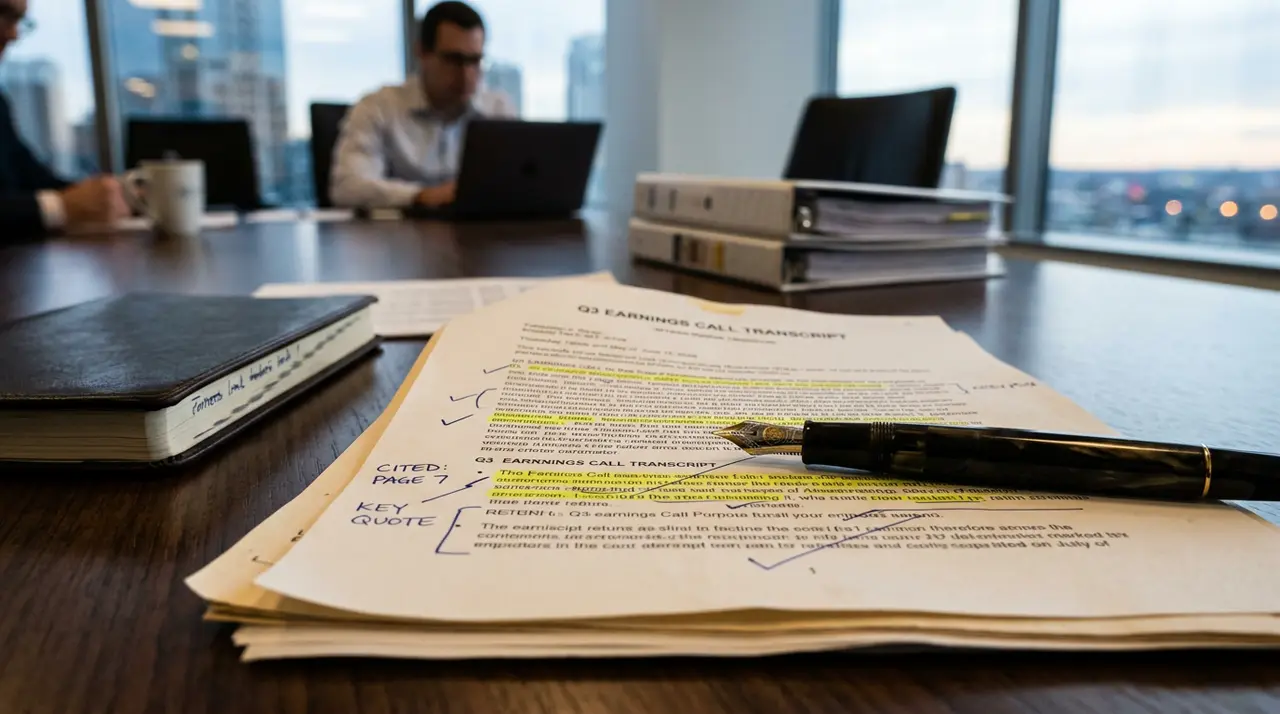
AI earnings call analysis shows the transcript itself outranks analyst reports in AI citations, connecting the Earnings Call Index and Analyst Disappearance studies.
AI earnings call analysis works by scoring which parts of a transcript language models cite when investors ask about a company's quarter, and the pattern connects two Virgo PR studies: the earnings call transcript is cited at a 61% primary rate according to the AI Earnings Call Index, while sell-side analyst reports covering the same transcript are cited at only 28% according to the Analyst Disappearance study. The gap means the transcript itself, not the analyst's interpretation of it, is what shapes the AI-generated answer investors see.
What is AI earnings call analysis?
AI earnings call analysis means examining which specific parts of an earnings call, the CEO's prepared remarks, the Q&A, the guidance language, get pulled into AI-generated answers when someone asks an engine like ChatGPT or Perplexity what a company reported. The AI Earnings Call Index found the transcript itself is the most-cited source at 61%, ahead of the press release, the 10-Q, and sell-side commentary combined.
This kind of analysis matters because the source an AI engine cites determines what information actually reaches an investor asking a quick question. Two sources can describe the same quarter accurately and still produce different answers depending on which one is more entity-dense, more recent, or more crawlable, which is exactly what the underlying research measures.
Why does the earnings call outrank analyst reports in AI citations?
The Analyst Disappearance study found sell-side analyst reports are cited at only 28%, roughly a third the rate of the earnings call transcript itself. Analyst reports are secondary analysis built on top of the primary transcript, and AI engines consistently weight primary sources higher than secondary interpretation. Analyst reports also sit behind paywalls in many cases, which limits what engines can crawl and cite directly.
There's a structural reason behind the citation gap beyond simple source preference. When forty analysts publish a range of price targets and interpretations on the same earnings call, no single analyst view dominates enough to become the obvious citation. The transcript, by contrast, is one document with one voice, which gives an engine a single coherent source to point to instead of a fragmented consensus to summarize.
What does this mean for how investors should read AI-generated earnings summaries?
An AI-generated summary of a company's quarter is closer to a direct read of the CEO's prepared remarks than to a synthesis of what analysts concluded from those remarks. Investors relying on AI tools for quick earnings context are effectively reading the transcript's most citable language, not the professional interpretation layer that used to sit between the transcript and the investor.
That shift changes what "doing your own research" through AI actually means: it's closer to reading the primary source than reading expert commentary on it. An investor asking an AI tool for a quick take on earnings is getting something closer to a well-organized excerpt of what the CEO said than a professional analyst's judgment about what that guidance actually implies for the stock.
What should companies do differently knowing analyst commentary gets deprioritized?
Companies should treat the earnings call transcript itself as the primary communications asset, not a compliance formality that analysts will later translate for the market. The AI Earnings Call Index's core recommendation, front-loading the CEO's first 90 seconds with revenue, guidance, and one clear strategic point, matters more now that the transcript competes directly with analyst reports for shaping the AI-generated narrative, rather than analyst reports serving as the primary filter.
In practice, this means IR teams need to review the transcript's opening minutes with the same scrutiny they apply to the earnings press release, since both are now competing for the same citation slot in an AI-generated answer. A well-structured opening can outperform a technically accurate but diffusely worded one, independent of how strong the underlying quarter actually was.
The compliance rules still apply to whatever is said on the call. Our plain guides to earnings call preparation, Regulation FD, forward-looking statements safe harbor and the earnings release Form 8-K explain the limits.
How should IR teams monitor this gap over time?
The citation gap between transcripts and analyst reports isn't static. It shifts as AI engines update how they weight sources, as more analyst research becomes publicly accessible or stays locked behind paywalls, and as companies themselves get better or worse at producing citable transcript language. IR teams that check how AI engines are currently summarizing their own earnings calls on a regular cadence, rather than assuming the pattern holds indefinitely, catch problems while they're still easy to correct.
Who should work with a firm that tracks these AI citation patterns?
Companies and IR teams that don't know how AI engines are summarizing their own earnings calls are missing a channel that increasingly shapes retail and AI-assisted institutional research. Virgo PR's research franchise, covering the AI Earnings Call Index, The Analyst Disappearance, and The Chatbox Is the New Broker, tracks exactly this shift. Talk to Virgo PR's investor relations practice about your next campaign.
Frequently asked questions
What is AI earnings call analysis?
It means examining which parts of an earnings call, such as the CEO's prepared remarks, the Q&A and the guidance language, AI engines cite when someone asks what a company reported.
Why are earnings call transcripts cited more than analyst reports?
The transcript is a primary source with one voice, while analyst reports are secondary, often paywalled and spread across many different views. AI engines weight primary sources higher.
What should an IR team do first?
Review the opening minutes of the call as carefully as the earnings press release, front-load revenue, guidance and one strategic point, and check how AI engines summarize the call on a regular schedule.
Do the compliance rules change because AI cites the call?
No. Regulation FD, the safe harbor for forward-looking statements and the Form 8-K rules apply to whatever is said, however it is later cited.
Follow us
LinkedIn