
Fintech Regulatory Communications: SEC, MiCA, GENIUS Act
By Kyle Porter, Executive Vice President & Managing Director.
Updated November 20, 2026
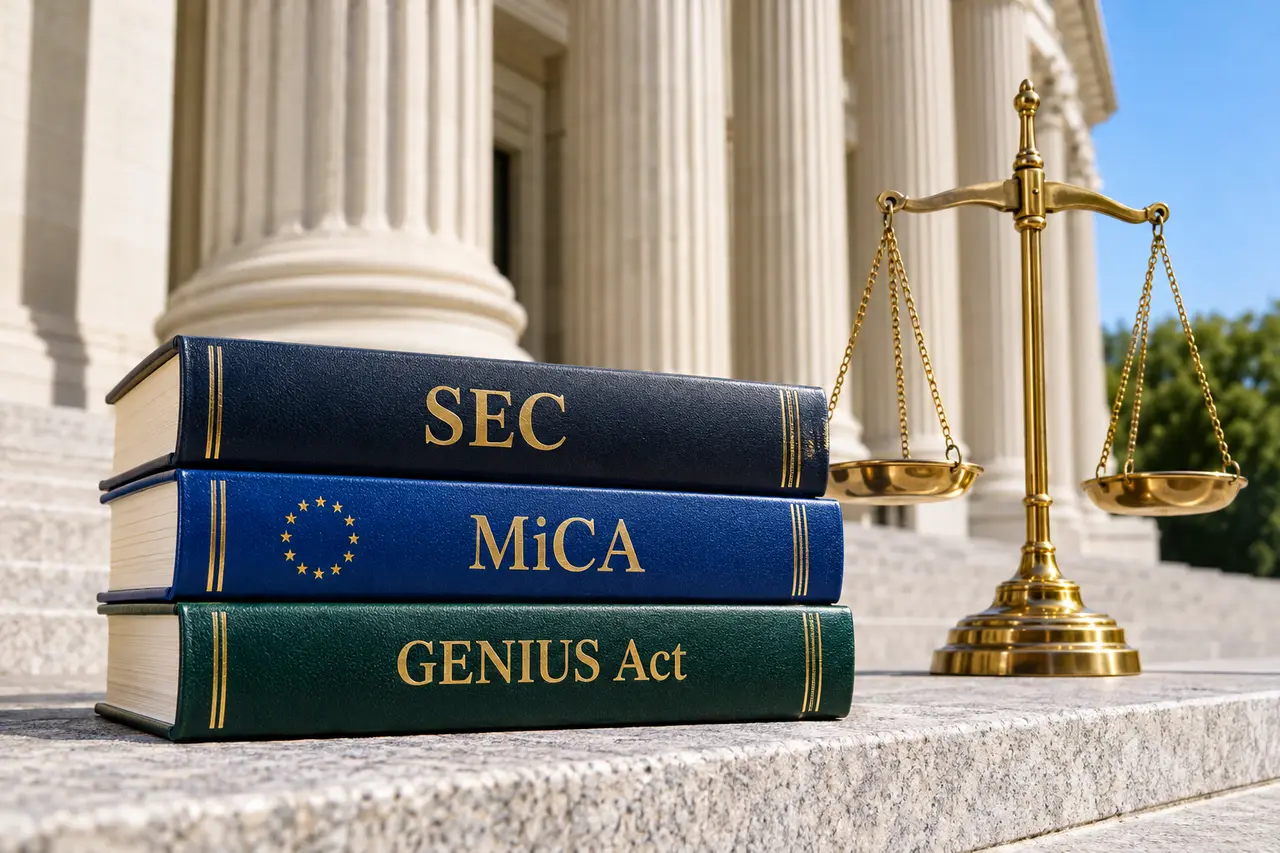
Fintech regulatory communications means the public statements a fintech or crypto company makes about licenses, approvals, rule changes and enforcement, and each statement has to match what the regulator has actually said or approved. In 2026 that means checking four rulebooks before release: the EU's MiCA, the SEC's token taxonomy and proposed Regulation Crypto Assets, the GENIUS Act for stablecoins, and the FCA's UK promotions regime.
Updated November 20, 2026. This guide is general information for communications teams, not legal advice. Counsel and compliance sign off on every regulatory statement.
What is in this guide?
What counts as a fintech regulatory communication?
A fintech regulatory communication is any statement that tells customers, investors or reporters what a regulator has licensed, approved, proposed or ordered. Four kinds come up most often: a license or authorization announcement, a reaction to a proposed or final rule, a product claim in a regulated category such as stablecoins, and a response to an inquiry or enforcement action.
The risk is the same in all four. A company says slightly more than the regulator did, and the extra words become the problem. Applying for a license is not holding one, and a proposed rule is not law. The sections below show where each rulebook draws that line.
Which rule governs which claim?
Each claim a fintech makes falls under a different rule, and the table below matches six common claims to the rule that governs them and the check to run before release.
ClaimGoverning ruleCheck before release
Offering or listing a token in the EUMiCA Article 7 (Articles 29 and 53 for asset-referenced and e-money tokens)White paper published first, and marketing matches it Offering crypto services in the EUMiCA service provider authorizationAuthorization held, and the regulator named Raising money with a token in the USSEC March 2026 interpretation and proposed Regulation Crypto AssetsToken category confirmed, and the proposal not described as law Describing a US payment stablecoinGENIUS Act marketing limitsNo government backing, guarantee or FDIC claim Promoting crypto to UK consumersFCA financial promotions regime, in force since October 8, 2023Authorized or approved sender, and a UK-specific review Telling investors about material newsRegulation FD and Form 8-KEveryone receives the news at the same time
How does MiCA limit crypto marketing in the EU?
MiCA limits crypto marketing in the EU by requiring that promotions for most tokens be identifiable as marketing, fair, clear, not misleading and consistent with the published white paper. Article 7 of the regulation, as published by the European Securities and Markets Authority, also requires the promotion to say that a white paper has been published, give the offeror's website, a telephone number and an email address, and carry a prescribed statement that no EU authority has reviewed or approved it.
The timing rule matters most to communications teams. Where a white paper is required, Article 7 bars any marketing before the white paper is published, although market soundings are still allowed. A teaser campaign, a countdown post or an influencer thread that goes out first is a breach, not a head start. Stablecoin issuers have parallel rules in Article 29 for asset-referenced tokens and Article 53 for e-money tokens.
Authorization claims changed on July 1, 2026. Law firm Hogan Lovells identified that date as the end of all MiCA transition periods and reported that 194 crypto-asset service providers were authorized as of May 2026. It also expected about 75 percent of the pre-MiCA registered providers to lose their status, as set out in its analysis of the MiCA deadline.
The same analysis reports that Italy's securities regulator CONSOB took the first enforcement action and fine against a public offer of crypto-assets made without a compliant white paper. For a release, the practical rule is to say "authorized" only when the national regulator's register shows it, and to name that regulator in the first paragraph.
What did the SEC change for token issuers in 2026?
The SEC made two changes in 2026: a March interpretation that sorts crypto assets into categories, and an August proposal for a token offering regime. On March 17, 2026, the SEC and CFTC issued an interpretation with a token taxonomy covering digital commodities, digital collectibles, digital tools, stablecoins and digital securities, according to the SEC's press release.
On August 18, 2026, the SEC proposed Regulation Crypto Assets and opened the proposal to public comment. White & Case's analysis of the proposal says comments were due October 20, 2026 and that the firm would not expect final rules before the first quarter of 2027. A release should therefore call it a proposal, and should not say a token "is not a security" as a settled fact.
One detail in the proposal reaches communications directly. White & Case notes that the proposed startup exemption covers only transactions after an issuer files a notice of reliance with the SEC, and that any earlier communication may count as an unregistered offer outside the exemption. It also says the required disclosures must be consistent with the issuer's white papers and other public statements. A token team that has been marketing for months needs counsel to review its past posts before relying on the exemption.
What can a stablecoin issuer say under the GENIUS Act?
A payment stablecoin issuer cannot say or imply that the coin is backed by the full faith and credit of the United States, guaranteed by the U.S. government or covered by FDIC insurance. The Senate Banking Committee's GENIUS Act fact sheet calls these strict marketing standards. It adds that a coin cannot be marketed so that a reasonable person would see it as legal tender or as issued or approved by the U.S. government, and that marketing a digital asset as a payment stablecoin is illegal unless the asset complies with the Act.
The Office of the Comptroller of the Currency applies the same limit through its final rule. Its community bank fact sheet says the rule requires issuers to disclose that payment stablecoins lack that backing, guarantee and insurance, and that it is unlawful to represent otherwise.
The same fact sheet says the rule restates the Act's ban on paying holders interest or yield solely for holding, using or retaining a coin, and that the OCC prohibits activities it determines evade that ban. A rewards program described with words like "earn" needs counsel's review before the launch announcement goes out. For plain-language examples of how brands word protection claims, see Virgo's review of fintech trust messaging across nine brands.
How do UK promotion rules affect crypto announcements?
A crypto announcement that a UK consumer can see and act on can be a financial promotion under the FCA's regime, which took effect on October 8, 2023. The FCA's review of firms' readiness, published as feedback on good and poor practice, says the rules in policy statement PS23/6 cover websites, blog posts and apps, and apply to promotions capable of having an effect in the UK regardless of where the firm is located.
The FCA found that firms using global websites and social accounts without controls to keep UK consumers out risked committing a criminal offense. It also said many examples of brand advertising went beyond the narrow category of image advertising, which covers only a firm's name, logo, contact point and the types of regulated activity or fees. And it said the rules would ban promotions offering any monetary or non-monetary incentive to invest, which reaches sign-up bonuses.
Enforcement followed the rules. Hogan Lovells reports that in October 2025 the FCA brought High Court proceedings against HTX, formerly Huobi Global, for illegally promoting crypto-asset services to UK consumers. For a global brand, the lesson is to decide which entity speaks to UK audiences and to geo-restrict everything else.
Does a quieter CFPB mean less regulatory risk?
A quieter CFPB does not mean less regulatory risk for a fintech, because state regulators, attorneys general and private plaintiffs are still active. Alston & Bird's May 2026 Fintech Case Files reports that a federal judge ruled on December 30, 2025 that the CFPB could not decline to request funding. It also reports that the bureau's restructuring plan would cut the enforcement division to 50 people and supervision to 77.
The same publication lists state action over the same months. California's Department of Financial Protection and Innovation announced on January 14, 2026 that crypto-backed lender Nexo Capital would pay $500,000 for operating a lending program for more than four years without a license. New Hampshire's attorney general announced on December 22, 2025 a $1.75 million settlement with PayPal over advertising claims, including a Purchase Protection promise and a statement that customers could access their funds at any time.
Advertising claims were the core of the PayPal case. A line such as "access your funds anytime" belongs in a release only if the product terms support it in every case.
How do you announce a license, approval or rule change?
Announce a license, approval or rule change by repeating the regulator's own wording, naming the regulator, and holding the release until counsel has matched every claim to a source document. Six steps keep that discipline.
-
Use the status word the regulator's document uses, such as applied, approved, authorized or registered, and no stronger word.
-
Name the regulator, the license type and the jurisdiction in the first paragraph.
-
Date the claim and link to the regulator's register or notice, because a status can change.
-
Label proposals as proposals, with the comment deadline or expected timing if the source gives one.
-
Match the release to the white paper, filing or product terms already in use, since the two must agree.
-
Send the same text to every channel at the same time, including executives' personal accounts.
Channel discipline is an SEC point as well as a communications one. According to the SEC's April 2, 2013 report of investigation, Netflix chief executive Reed Hastings posted on his personal Facebook page on July 3, 2012 that monthly viewing had passed one billion hours for the first time. The report says the company had not used that page for company metrics, and that no press release or Form 8-K accompanied the post.
In the same report, the SEC said it would not bring an enforcement action. It also said social media disclosures need the same Regulation FD analysis as other channels, and that investors should be told in advance which channels a company will use. Virgo's Regulation FD guide covers the rule in full, and a release that predicts an approval date also needs the language in the forward-looking statements safe harbor guide.
What should an inquiry or enforcement statement include?
A statement about a regulatory inquiry or enforcement action should say what is confirmed, what the company has been asked to do, what customers should do next and when the next update will come. It should not predict the outcome. The structure is the same one used in Virgo's review of three crypto exchange hack responses.
Use the order's own wording about fault. Alston & Bird's summaries show that Nexo neither admitted nor denied the California findings and that PayPal settled without admitting wrongdoing. A company statement should repeat that language rather than say it was "cleared" or "exonerated." Virgo's study of five fintech PR campaigns shows how regulators and markets responded to brands' public claims.
What should a regulatory claim register contain?
A regulatory claim register is a one-page table that lists every regulatory claim a company intends to make, the document that supports it, the date of that document and the person who checked it. Build it before the next announcement, and hold any release that cannot fill every row.
Keep the register next to the company's approved boilerplate so that a license, a pending application and a proposed rule are never described in the same breath. Teams that need outside support on financial and crypto announcements can see Virgo's financial public relations and crypto and Web3 PR pages.
Frequently asked questions
What is a regulatory communication for a fintech?
A regulatory communication is any statement about a license, approval, rule, inquiry or enforcement action that a regulator has issued or could issue. It has to match the regulator's own document.
Can a crypto company say it is regulated?
Only if a regulator's register shows the specific authorization, and the statement should name the regulator and the activity covered. The FCA treats firms registered under the Money Laundering Regulations differently from authorized firms, and says registered firms cannot approve third-party promotions.
Is Regulation Crypto Assets in force?
No. The SEC proposed it on August 18, 2026, and comments were due October 20, 2026. White & Case says it would not expect final rules before the first quarter of 2027, and a final rule could differ from the proposal.
Does MiCA apply to a US company?
MiCA's Article 7 covers marketing communications relating to an offer to the public of a crypto-asset, or its admission to trading, in the EU. A US company marketing a token to EU buyers should have EU counsel review the promotion and the white paper.
Who should approve a fintech regulatory announcement?
Counsel and compliance should clear the text, and a named spokesperson should deliver it. A public company also needs securities counsel to confirm that Regulation FD and Form 8-K timing are met.
Can a stablecoin issuer promote rewards or yield?
The GENIUS Act bars permitted payment stablecoin issuers from paying holders interest or yield solely for holding a coin, according to the OCC. Any rewards wording should go to counsel before launch.
Follow us
LinkedIn