Expertise · October 18, 2026
California High-Speed Rail Delay Communications Review
By Kyle Porter, Executive Vice President & Managing Director.
Updated October 21, 2026
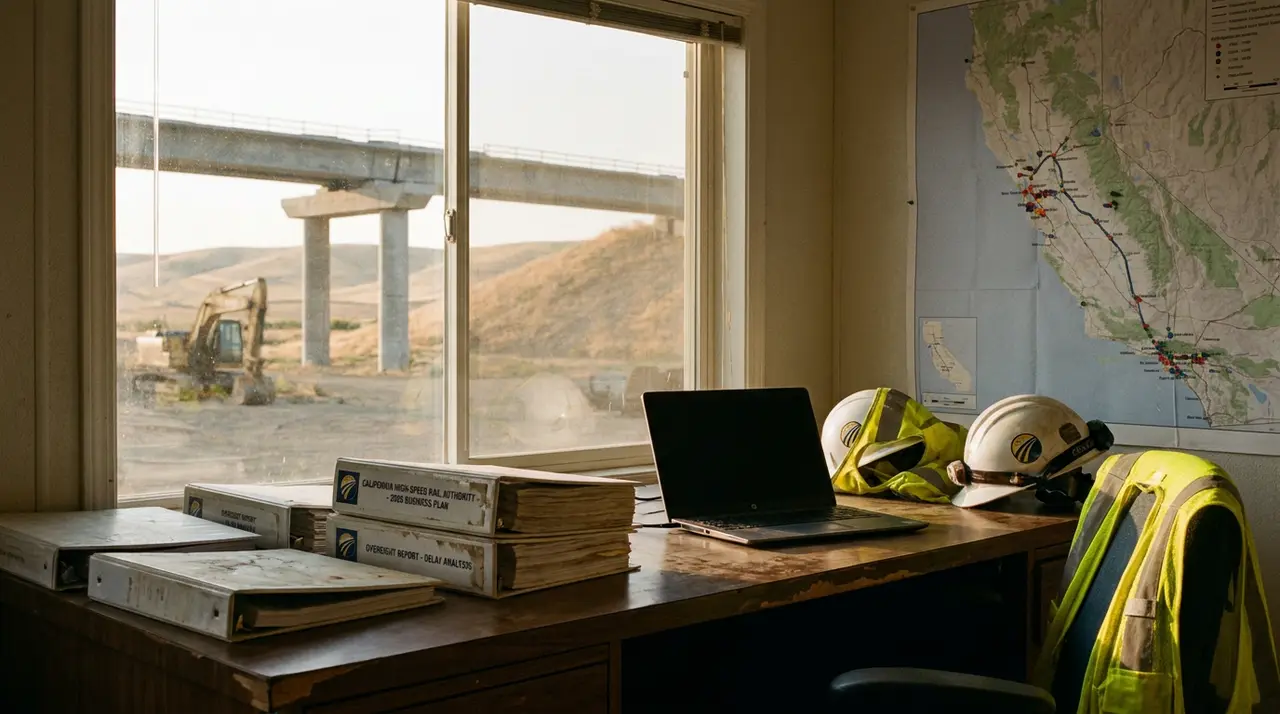
California's high-speed rail 2026 business plan shows what happens when delay and cost changes are not communicated plainly. According to reporting, the state's inspector general said the plan did not explain a nine-month schedule slip, placed a fuller cost estimate in a risk section, and left out financing costs that could push one segment from $36 billion toward $48 billion. This review lays out each point with its source.
Updated October 18, 2026.
This is an analysis of how a public infrastructure owner communicated change, not a verdict on the project itself. Every figure below is attributed to the outlet or oversight body that reported it, and where numbers differ we say so.
What did the 2026 business plan announce?
The California High-Speed Rail Authority's 2026 business plan focused on completing an initial segment between Merced and Bakersfield by 2033. The draft, released in February, put that segment at about $36 billion, according to the San Joaquin Valley Sun. The final plan put it at about $35.7 billion, per a report carried by TurnTo10, which also described a funding gap of $86.8 billion for the full San Francisco to Los Angeles and Anaheim system.
The wider system was priced separately. KTLA reported that the Los Angeles to San Francisco segment was estimated at about $126 billion with service beginning around 2040, and that without cost-saving measures officials estimated it could have cost as much as $231 billion.
The plan also changed the project's shape. The Sun reported that it moved the proposed Merced station from downtown to a more suburban location and shifted from a double-track to a single-track line, which raised questions among lawmakers about whether the project would still qualify as high speed. KTLA later reported that the approved plan removed the planned downtown Bakersfield station.
What did oversight officials say was unclear?
Oversight officials said the plan left out explanations a reader would need to compare it with earlier ones. The Sun reported that the board postponed a planned vote on the draft after criticism from state lawmakers and officials who said it lacked transparency and omitted key cost details, and that Inspector General Benjamin Belnap and a Legislative Analyst's Office representative told lawmakers the required year-to-year cost comparisons and a comprehensive funding strategy for the Merced to Bakersfield segment were missing.
The inspector general's later review of the final plan was more specific. KMPH reported four findings from the review:
-
The plan did not adequately explain scope changes and cost increases between earlier and current estimates for the Merced to Bakersfield segment, which the review said obscured that, without scope reductions, costs had increased substantially.
-
The plan placed an estimate for a full-scope segment that complies with state law in the section on managing risks, not in the section describing project costs.
-
The plan acknowledged that the schedule slipped nine months between August 2025 and March 2026 but did not explain the "optimization and pending policy changes" it gave as the cause.
-
The plan did not clearly disclose that the schedule window for the segment is no longer 2032 to 2033.
How did the plan's numbers differ across sources?
The plan's numbers differed by source and by what each figure included. Straight Arrow News reported that the plan cites a reduction of roughly $1 billion from the 2025 estimate for the Merced to Bakersfield segment, with a current estimate of around $36 billion, while the inspector general's report put the true cost closer to $48 billion because of excluded financing and settlement costs.
The same report said the authority could run out of money for the project as early as next year, and that if the authority ever builds to downtown Bakersfield at a later, unknown date, the cost will likely be higher than estimated.
In other words, three figures circulated for one segment: about $36 billion in the draft, about $35.7 billion in the final plan, and about $48 billion in the inspector general's analysis. A reader repeating any of them needs to say which version and what it includes.
How did the authority respond publicly?
The authority responded by stressing progress and savings. KTLA reported that CEO Ian Choudri struck an optimistic tone at a board meeting, saying track laying between Bakersfield and Merced was expected to begin by the end of the year. According to TurnTo10, after the board unanimously voted to advance the final plan, an authority spokesperson said the plan produced savings even from the draft, bringing the segment to about $35.7 billion, and that the authority believed it could provide service from Merced to Bakersfield by 2033.
KTLA also reported that Choudri had enacted a series of cost-cutting and time-saving measures aimed at the 2033 goal.
The savings framing has a limit. A saving measured against a draft shows movement, but it does not answer the inspector general's point that the plan did not explain how scope changes affected cost between earlier estimates and the current one.
What can an infrastructure owner learn about delay communications?
An infrastructure owner can learn that a delay message is judged on whether a reader can reconstruct what changed, why and what it cost. The oversight findings above translate into five habits.
-
Name the cause. A reason such as "optimization and pending policy changes" gave reporters and auditors nothing to check. State what was optimized and which policy.
-
Put the full number where costs live. A full-scope estimate in a risk section reads as hidden, whatever the intent. Present it with the main cost figures.
-
Show the bridge between estimates. A year-to-year comparison that itemizes scope changes lets readers see whether a lower number reflects savings or a smaller project.
-
Say when a window moves. If a 2032 to 2033 range becomes a later date, state it as a change, not by omission.
-
Disclose what a figure excludes. Financing and settlement costs were the difference between $36 billion and $48 billion in the inspector general's analysis.
The same principle runs through our analysis of Key Bridge collapse communications, where a published checkpoint list kept a long recovery visible even when the date slipped. For a manufacturing parallel on announcing dates and changing them, see our comparison of factory opening announcements. This post is part of Virgo's physical economy PR guide, which maps the patterns across 19 cases.
Frequently asked questions
What did the inspector general say about the business plan?
According to KMPH, the review said the plan did not adequately explain scope changes and cost increases, placed a full-scope estimate in a risk section, did not explain a nine-month schedule slip and did not clearly disclose that the 2032 to 2033 window no longer applied.
How much does the Merced to Bakersfield segment cost?
It depends on the source. The draft said about $36 billion, the final plan about $35.7 billion, and the inspector general's report put it closer to $48 billion when financing and settlement costs are included.
How should a project owner explain a delay?
State the cause specifically, say what changed and by how much, restate the new date or window as a change, and show how the cost moved and why.
Why does the placement of a cost estimate matter?
Readers look for costs in the cost section. The inspector general's review said a full-scope estimate sat in the risk section, which made it easy to miss.
Is a savings claim enough to answer cost questions?
Not on its own. A saving measured against a draft shows movement, but readers also need to see how scope changes affected cost between earlier and current estimates.
Follow us