Expertise · October 21, 2026
Cleantech PR Campaigns: 4 Climate Tech Cases Compared
By Kyle Porter, Executive Vice President & Managing Director.
Updated October 21, 2026
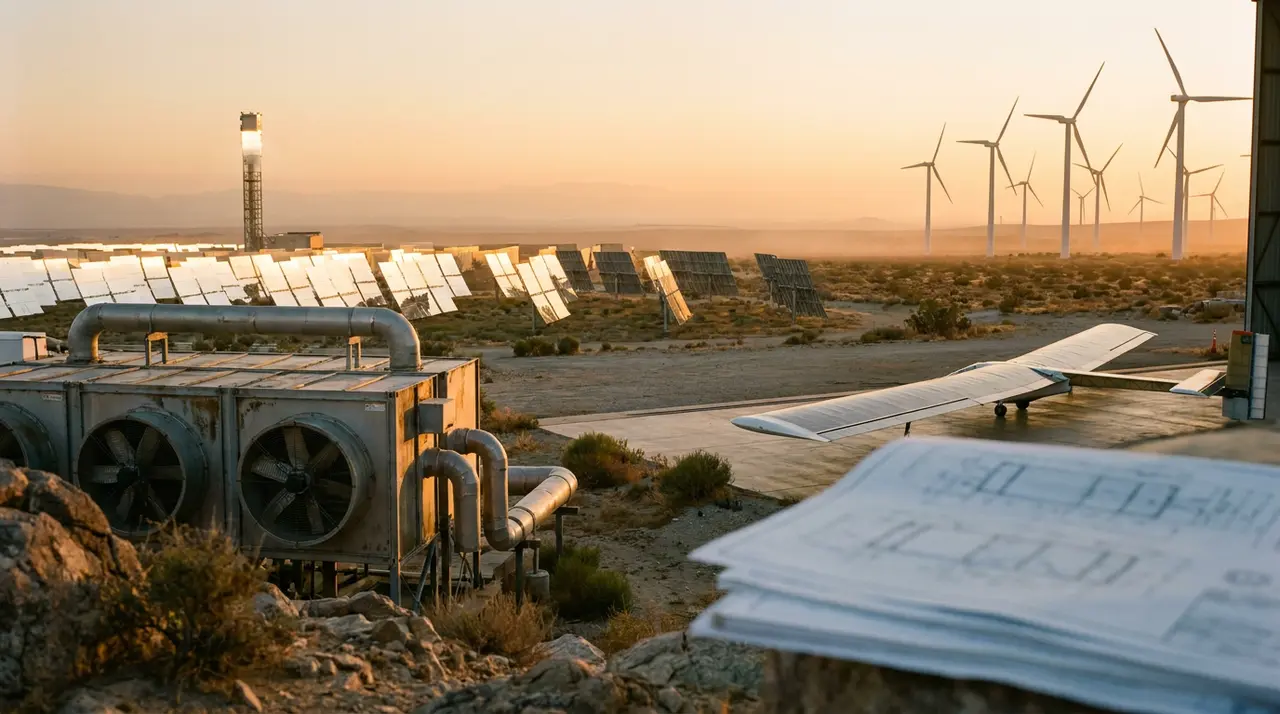
Cleantech PR campaigns earn lasting coverage when the claim matches what the technology can show on a given day. Climeworks, Heliogen, Solar Impulse and Ørsted show four versions: a capacity figure that outran output, a temperature record that outran its commercial results, a flight that proved a technology by finishing, and a rename announced after the oil and gas sale had closed.
The sharpest number comes from Climeworks. Its Mammoth plant in Iceland was designed to capture up to 36,000 tonnes of CO2 a year, and the company reported 675 tonnes of net removal in the first half of 2026, according to a Net Zero Compare report published September 16, 2026. The other three cases show how a brand can set up, or avoid, that kind of gap.
How did Climeworks handle the gap between capacity and output?
Climeworks, the Swiss direct air capture company, announced its Mammoth plant in Iceland with a design capacity of 36,000 tonnes of CO2 a year, and its own September 2026 update shows output still far below that figure. AFP reported at the May 2024 inauguration that Mammoth started with the first 12 of 72 planned collector containers, and that Climeworks expected capacity at its Icelandic site to rise from 4,000 tonnes a year at the earlier Orca plant to about 40,000 once Mammoth ran in full.
In that September 2026 update, Climeworks reported 675 tonnes of net carbon removal at Mammoth in the first half of 2026, compared with 119 tonnes in the first half of 2025. It also said upgraded collector containers now reach the original design rate of about 1.37 tonnes of CO2 per container per day, roughly double the performance of the original units.
Net Zero Compare explained why the word net matters. Nameplate capacity measures theoretical capture potential, while net removal subtracts energy use, operational emissions and downtime. Climeworks said operating cost per tonne at Mammoth fell by more than 50 percent over the past year, but it did not disclose the resulting cost per tonne, which makes comparison with other carbon removal projects difficult.
The update worked as communication because it set the shortfall beside the improvement in the company's own numbers. Net Zero Compare gave a full section to the fact that Mammoth remains far below nameplate capacity, so the gap traveled in the same story as the progress. Climeworks also named two dated next steps: upgrading all 12 containers in one Mammoth module by the end of 2026, and testing its next-generation technology at the site in early 2027.
What happened after Heliogen reported 1,000 degree solar heat?
Heliogen, a California concentrated solar company backed by Bill Gates, announced on November 19, 2019 that it had concentrated sunlight to more than 1,000 degrees Celsius at a facility in Lancaster, California. E&E News reporter Carlos Anchondo wrote on November 20, 2019 that the company called the result a key technical breakthrough, that Gates called it a promising development, and that existing concentrating solar systems reached about half that heat.
The same E&E News report carried three outside voices. Rebecca Walsh Dell, an industry strategist at the ClimateWorks Foundation, said 1,000 degrees is not high enough for the central processes in cement and steel, and noted that one component of a cement kiln needs roughly 1,500 degrees. Jeffrey Rissman, industry program director at Energy Innovation, said the announcement lacked technical details. Mark Mehos, a concentrating solar power program manager at the National Renewable Energy Laboratory, said that if the temperatures could be reached reliably and cost-effectively, the technology would reach beyond the current market for concentrating solar.
Heliogen's later filings tell the rest. The company completed a business combination with Athena Technology Acquisition Corp. on December 30, 2021, according to its filing with the U.S. Securities and Exchange Commission. In its March 27, 2025 results release, Heliogen said it and Woodside Energy had decided not to pursue the Capella facility in Mojave, California, which was designed to demonstrate next-generation thermal storage, and that it had halted construction of a steam plant in west Texas. The company ended 2024 with $36.9 million in liquidity.
The same release described Heliogen's current commercial offering as built on thermal energy storage already deployed in existing concentrated solar power plants. Zeo Energy completed its all-stock acquisition of Heliogen in August 2025, according to a Zeo press release dated August 11, 2025.
The lesson sits in the order of events. A temperature figure answered whether the physics worked, and the first outside reporting asked the customer's question: does the heat reach the process that burns fuel today? A launch can state that gap and a date for closing it, so the reporter's paragraph about what is missing is one the company already wrote.
Why did the Solar Impulse flight work as a cleantech campaign?
The Solar Impulse 2 flight worked as a campaign because its finish line was public, countable and certified by an outside body. Swiss pilots Bertrand Piccard, the project's initiator and chairman, and André Borschberg, its co-founder and chief executive, flew the solar-powered aircraft around the world in 17 legs, leaving Abu Dhabi on March 9, 2015 and landing there on July 26, 2016, according to the World Air Sports Federation.
The federation counted more than 42,000 kilometres, more than 555 hours of flight, 16 stops, nine countries and 19 world record claims from the team. Borschberg's leg from Nagoya, Japan to Hawaii lasted nearly 118 hours and broke the federation's record for the longest uninterrupted solo flight by duration.
Piccard also turned a flight leg into a media event. On April 22, 2016, Earth Day, he held live conversations from the cockpit over the Pacific with entrepreneur Richard Branson and United Nations Secretary General Ban Ki-moon, on the day more than 175 nations signed the Paris Climate Agreement, the federation reported.
Setbacks became part of the story rather than a break in it. Flying magazine reported that the plane waited months in Asia for weather and that the team aborted its first attempt at the Pacific crossing, and Aviation Today reported that the batteries overheated during the longest leg. Live Science reported that the flight resumed with a Hawaii to California leg in April 2016.
A flight proves a technology can work once, not that anyone can buy it. After landing, the team said it would continue advocacy through a new International Committee for Clean Technologies and develop solar-powered drones, Aviation Today reported. A smaller brand can copy the structure: a public finish line, an outside body that counts, and a claim limited to what the demonstration proved.
What did Ørsted's rename show about timing a brand change?
Ørsted showed that a rename lands best after the asset change it describes has closed. The company, then called DONG Energy, completed the sale of its upstream oil and gas business to INEOS on September 29, 2017, and chief executive Henrik Poulsen told employees on October 2, 2017 that the company would become Ørsted, according to an offshoreWIND.biz report on the rename.
The old name, DONG, stood for Dansk Olie og Naturgas, or Danish Oil and Natural Gas. The new name came from Hans Christian Ørsted, the Danish scientist who discovered electromagnetism in 1820. Poulsen told staff, "We are no longer the company we were ten years ago," according to the same report.
The rename followed public steps that had already happened. DONG Energy decided in November 2016 to exit oil and gas, announced the sale agreement with INEOS in May 2017, and said it would phase out coal at its power stations by 2023, offshoreWIND.biz reported.
Outlets did not agree on the sale price. The Chemical Engineer reported US$1.05 billion, while Industrial Info reported $1.3 billion. A brand that cites a transaction figure in a rename announcement should use the number its own filings support.
The contrast with Heliogen is the order. Ørsted's facts came first, so the new name described something a reporter could verify the same day, while Heliogen's launch described a result whose commercial meaning had not yet been tested.
Which cleantech claims held up, and what can a brand copy?
The four cleantech claims held up to different degrees, and the public record separates them by whether the evidence existed on announcement day.
CaseClaim at announcementWhat the record showsWhat a brand can copy
Climeworks Mammoth36,000 tonnes a year design capacity675 tonnes of net removal in the first half of 2026Publish net results with a prior-period comparison and dated next steps HeliogenSolar heat above 1,000 degrees Celsius (2019)An outside expert said a cement kiln component needs about 1,500 degrees; the Capella project was not pursued in 2025State the customer gap and the date for closing it Solar Impulse 2First solar flight around the worldCompleted July 26, 2016, with 19 world record claims filedUse a public finish line that an outside body counts ØrstedA renewable energy identityRename announced after the oil and gas sale closedChange the name after the asset change has closed
A cleantech team deciding what to announce next can apply four steps drawn from these cases.
-
Publish net results next to nameplate figures, with the prior period beside them.
-
Put the customer's open question in the launch material, with the date the company expects to answer it.
-
Choose a milestone that an outside body can count or certify.
-
Announce an identity change after the sale, closure or launch it describes has closed.
The test behind all four steps is simple: could a reporter find the missing number in a filing or an expert's quote before reading the press release? If so, the release should contain it.
Related reading on this site includes the industrial sustainability PR lessons from GE, Siemens, Interface and Maersk, the physical economy PR guide built from 19 cases, the nuclear power deal announcements comparison, the energy infrastructure PR agency guide, and the cleantech PR agency page.
Follow us