Expertise · October 18, 2026
EV Charging Network Announcements: 3 Cases Compared
By Kyle Porter, Executive Vice President & Managing Director.
Updated October 21, 2026
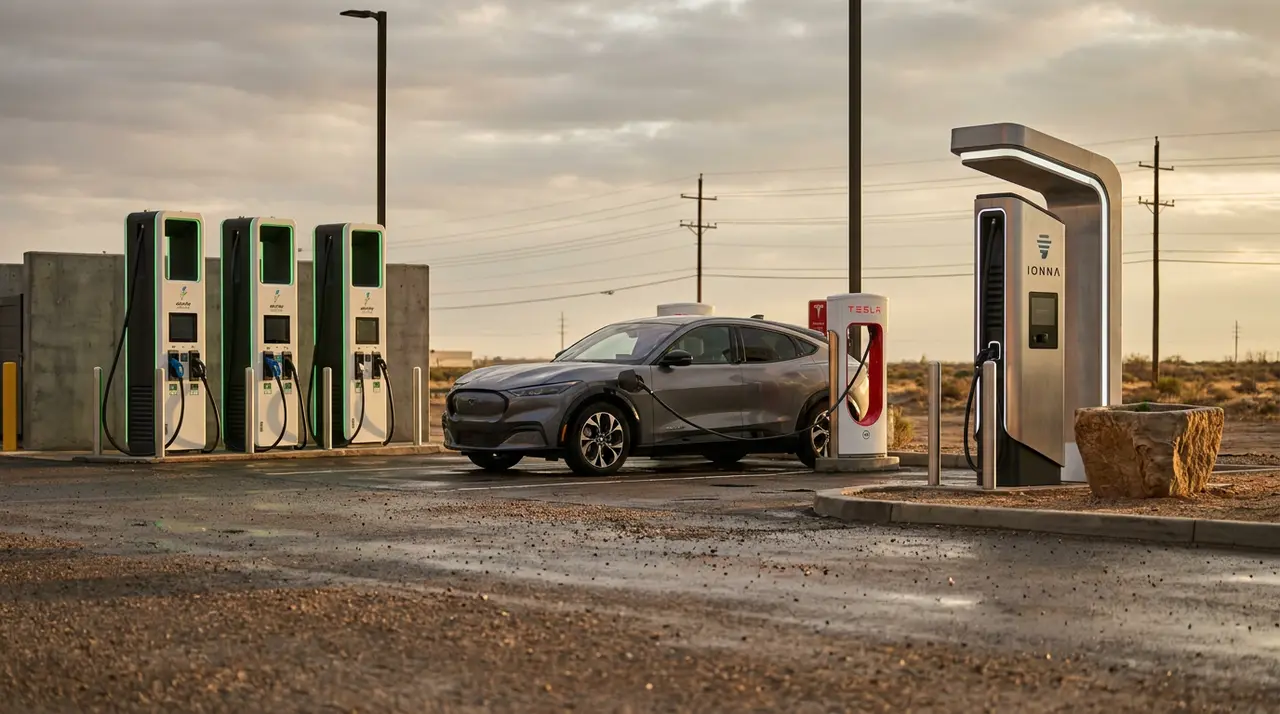
EV charging network announcements earn coverage when they pair a headline target with a schedule, a named structure and numbers a reporter can check. Volkswagen's Electrify America began as a court-ordered $2 billion commitment, Ford and Tesla announced charger access in a live conversation between their chief executives, and the Ionna coalition set a 30,000-charger target and kept it through a funding shock. Each case below names its mechanism and what a charging brand can copy.
Updated October 18, 2026.
None of the sources below say a PR team planned these moves, so treat them as repeatable mechanisms, not agency case studies. We started from a longer list and kept only the cases we could source.
How were these three charging announcements chosen?
Virgo chose three charging announcements that a company release or a major outlet documents, that carry figures a reporter can check, and that named a spokesperson or institution. Each one used a different mechanism: a regulatory commitment, a partnership between rivals and an industry coalition.
The selection is a judgment, not a ranking. Other charging companies have made announcements, and we left them out where we could not verify the details. This post focuses on the network and infrastructure side, which is business-to-business. For fleet buyers who use these networks, see our guide to EV and mobility PR.
How did Electrify America turn a settlement into a launch?
Volkswagen Group of America announced Electrify America on February 7, 2017 as a subsidiary to manage $2 billion in zero emission vehicle investments over ten years, required by its diesel emissions settlement, according to Reuters. The unit planned more than 500 charging stations, including a high-speed cross-country network of more than 200 stations, and the settlement required $800 million to be spent in California and $1.2 billion elsewhere. Reuters also reported that charging stations had to be accessible to all vehicles and education spending had to be brand neutral.
The program came with a schedule. Electrek reported that VW would make four $500 million investments, one every 30 months, each needing approval from regulators. The Detroit Bureau later reported that the first national investment cycle called for 2,500 chargers at 450 stations, spaced an average of 66 miles apart.
Reported figures differed. Reuters described more than 300 stations in 15 metro areas, while a Bloomberg report carried by The Gazette described more than 300 chargers in 15 metro areas, and noted that some lawmakers worried the required spending could give VW an edge in the charging market. A later TechCrunch report said Electrify America planned to double its network to 1,800 stations, or 10,000 chargers, and noted it had installed 635 stations at that point.
Why it works: In Virgo's read, a fixed dollar figure, a regulator-approved schedule and named corridors gave reporters a scorecard they could update at every milestone, and the later doubling announcement showed the plan scaling.
Copy this: Publish the total, the phases and the spacing rule together, and report progress against the same numbers each time.
How did Ford and Tesla announce Supercharger access?
Ford CEO Jim Farley and Tesla CEO Elon Musk announced on May 25, 2023 that Ford electric vehicles would gain access to more than 12,000 Tesla Superchargers, using a live Twitter Spaces conversation, according to Ford's release. The release said a Tesla-developed adapter would give Mustang Mach-E, F-150 Lightning and E-Transit owners access, and that Ford expected to equip future EVs with the NACS port from 2025.
The Associated Press, as carried by ClickOnDetroit, reported that no financial arrangement between the companies was announced, that Farley said owners would pay a cost such as a monthly subscription without giving specifics, and that about 18,000 people were listening at the start of the chat. Axios added that next-generation Ford EVs with the new connector would need an adapter to use non-Tesla chargers.
Counts differed. Ford said 12,000 plus Superchargers, while the AP said Tesla had about 17,000 Supercharger stations in the US, which may be a difference between stations and individual chargers. Ford also cited more than 10,000 fast chargers in its own network, while Axios cited more than 84,000 chargers, a figure that probably includes slower ones.
Why it works: In Virgo's read, two rival chief executives on one live call gave reporters a quotable moment and a visual of cooperation, and specific dates (the adapter first, the native port from 2025) made the plan checkable. What the announcement left out, the price, drew the follow-up questions.
Copy this: Pair a partnership announcement with a dated, two-step rollout, and prepare an answer on price before a reporter asks.
How did Ionna keep a charging target through a funding shock?
Ionna, the charging joint venture of automakers, repeated its goal of at least 30,000 high-powered chargers by 2030 each time its situation changed. Utility Dive reported in 2024 that the seven-automaker venture had received regulatory approval, would feature multiple high-powered chargers at each location, and, by offering the CCS plug, could access $7.5 billion in federal funding. Electrify News later reported that Toyota joined as another investor.
In February 2025 Ionna moved from public beta to a full national release, and Utility Dive reported that it stood by the 30,000 target even though federal action the previous week suspended billions in funding. The company said it was on track to add more than 1,000 charging bays that year, and that Sheetz planned chargers at more than 50 of its locations by the end of 2026. TFL Car reported the company's beta figures: more than 4,400 charging sessions on more than 80 vehicle models, dispensing nearly 63,000 kilowatt-hours.
One date is inconsistent. TFL Car's article said the network launched in February 2024, while Utility Dive reported the national release as February 2025. A reader should rely on the dated announcement.
Why it works: In Virgo's read, a single memorable target, repeated, gave the coalition a constant reference point, and publishing test data turned a promise into early evidence.
Copy this: Pick one target and restate it in every update, publish early usage data, and answer external shocks with the same number rather than a new one.
What evidence backs each of the three announcements?
Each announcement rests on a company statement or a major outlet that names its figures. The list below shows the key figures, the evidence and the source type, so a reader can check each one.
-
Electrify America (February 2017): $2 billion over ten years, $800 million in California and $1.2 billion elsewhere, four $500 million investments. Evidence: Reuters, Electrek and The Detroit Bureau. Source type: wire and trade reporting.
-
Ford and Tesla (May 2023): access to more than 12,000 Superchargers, adapter first and the native NACS port from 2025, no financial terms announced. Evidence: Ford's release, the Associated Press and Axios. Source type: company release and wire reporting.
-
Ionna (2024 to 2025): at least 30,000 chargers by 2030, 4,400 beta sessions, more than 1,000 bays planned in 2025. Evidence: Utility Dive and TFL Car. Source type: trade reporting of company statements.
In Virgo's read, the cheapest route for a charging brand is the Ionna one: a target, regular updates and early data, all of which a company can publish itself.
A claim without a document gives an editor nothing to verify. A charger count with no stated basis, for example, cannot be checked, so it rarely supports a news story on its own.
Which mechanism fits your charging brand?
The three mechanisms differ in the asset a brand must own before it can use them. The list below pairs each mechanism with that asset, based on Virgo's assessment of the three examples.
-
Electrify America, a regulator-approved plan: a funded, scheduled commitment. Best fit: operators with mandated or approved programs.
-
Ford and Tesla, a live partnership announcement: two senior spokespeople and a dated rollout. Best fit: companies announcing access or interoperability.
-
Ionna, a coalition target with data: a single number, repeated, with early usage figures. Best fit: networks still building out.
What should a charging brand do first?
A charging brand should list the numbers it can publish and keep their definitions fixed. Decide whether you are counting stations, chargers or charging bays, because the cases above show how quickly counts diverge.
Then choose the one target to repeat, write the dated schedule behind it, and prepare answers on price and funding. See also our roundup of manufacturing PR campaigns and our analysis of fleet electrification PR, which cover the buyers of this infrastructure. This post is part of Virgo's physical economy PR guide, which maps the patterns across 19 cases.
Frequently asked questions
What makes a charging announcement earn coverage?
A headline target with a schedule and a named structure. Each case above gave reporters figures they could update later.
Why do charger counts differ between sources?
Stations, chargers and bays are different units. Coverage of Ford and Tesla showed the same network described as 12,000 and 17,000, so define your unit.
Should an announcement include pricing?
Ideally, or a prepared answer. The Ford and Tesla announcement left price open, and reporters asked about it.
How can a coalition keep a target credible?
By repeating one number and publishing early data. Ionna restated its 30,000 goal after a funding shock and released beta usage figures.
Do charging brands need a regulator to make a big announcement?
No. Electrify America had one, but Ford and Tesla and Ionna built their announcements from partnerships and public targets.
Follow us