Expertise · October 18, 2026
Megaproject Delay PR: Gordie Howe vs Elizabeth Line
By Kyle Porter, Executive Vice President & Managing Director.
Updated October 21, 2026
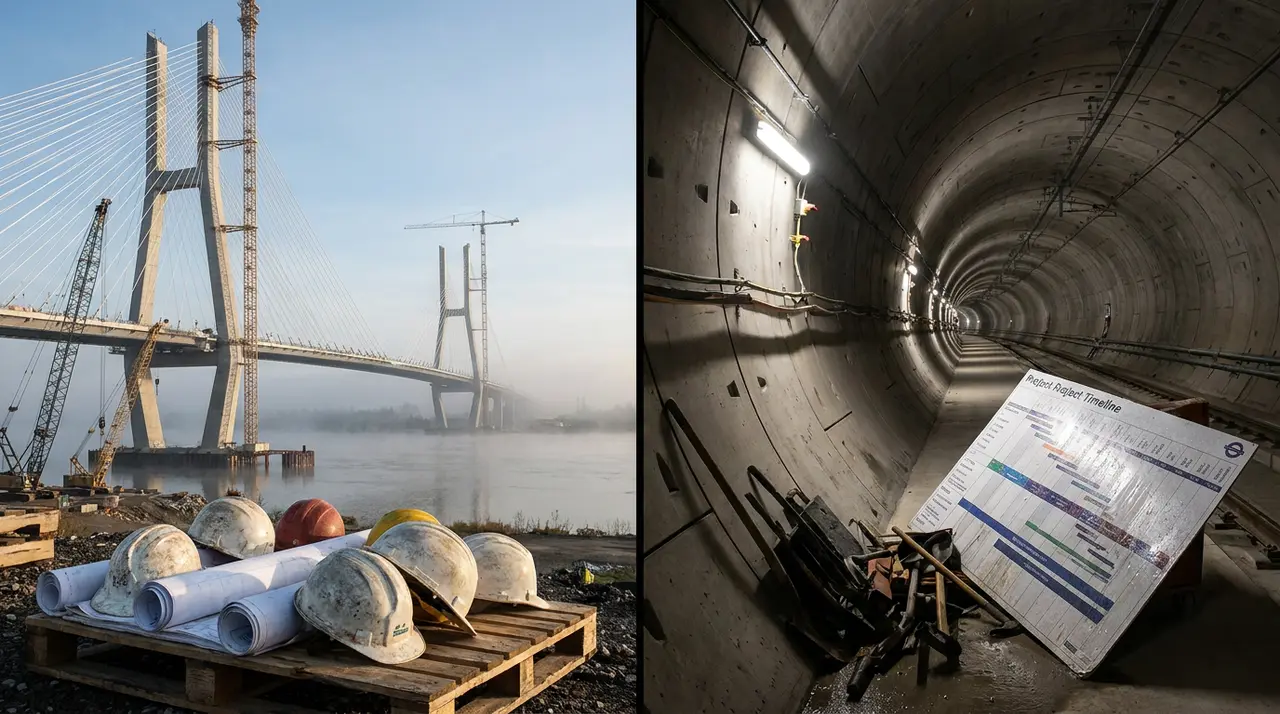
Megaproject delay communications work when an owner explains the cause of a slip, commits to a date only when it can keep it, and says what is still not ready. The Gordie Howe International Bridge repeated one conditional phrase through several postponed openings before it opened on July 27, 2026, and London's Elizabeth line moved from a vague window to a dated opening twenty days out. Each case below names its mechanism and what a project owner can copy.
Updated October 18, 2026.
None of the sources below say a PR team planned these moves, so treat them as repeatable mechanisms, not agency case studies. We started from a longer list and kept only the cases we could source.
How were these two megaprojects chosen?
Virgo chose two megaprojects that major outlets and the owners' own statements document, that carry dates and figures a reporter can check, and that went through visible delays before opening. Both are cross-border or capital-city infrastructure with public owners, so their communications were scrutinized.
The selection is a judgment, not a ranking, and it covers only the cases we could source. For a third case where oversight bodies faulted the communication itself, see our review of California high-speed rail delay communications.
How did the Gordie Howe bridge authority communicate repeated delays?
The Windsor-Detroit Bridge Authority tied every new date to the same condition: that opening depended on quality reviews, testing and commissioning. According to AM800, construction began in 2018 and the opening was originally slated for November 2024, then pushed to fall 2025 in January 2024, then to early 2026. A WDBA official told the Detroit News, as carried by Yahoo News, that the exact opening date would depend on ongoing quality reviews, testing and commissioning.
The authority also addressed cost directly. Crain's Detroit reported that WDBA's chief relations officer, Heather Grondin, said the delay did not affect cost and that the contract value remained C$6.4 billion. BlogTO quoted her saying that when it comes to the complexities of new international border crossings, taking the time to do it right is time well spent.
The pattern continued into 2026. CP24 reported in June that WDBA's director of communications repeated the same formula for a spring opening, that a US official said the contractor had missed a May 1 deadline, and that Canada's border agency had been operating on its side since fall 2025. WOOD TV reported that the bridge had been ready for several months but was held up by a dispute between the US and Canadian governments, which put the final date outside the authority's control.
The bridge opened to traffic on Monday, July 27, 2026, after a ribbon-cutting and hockey game, according to Renew Canada, which noted that the opening followed the contractor's achievement of the contractual milestone of Substantial Completion.
Why it works: In Virgo's read, a single repeated condition made each postponement read as consistent, not as a new excuse, and answering the cost question in the same breath kept the delay from becoming a budget story. The limit is that a phrase repeated across several slips can wear thin, and WOOD TV's report shows an owner can still lose control of the final date.
Copy this: State the condition that governs your date once, in plain terms, repeat it each time, and answer the cost question in the same statement.
How did TfL announce the Elizabeth line opening?
Transport for London announced the Elizabeth line's opening date twenty days ahead, after months of committing only to a window. City AM reported that TfL confirmed the central section would open on May 24, 2022, delivering on the promise its commissioner, Andy Byford, had made earlier in the year that the line would open in the first half of 2022. Trains reported the announcement date as May 5, 2022, and noted that the 73-mile, 41-station system was originally slated to open in 2018, with cost rising from £14.8 billion to £18.9 billion.
The announcement carried its caveats. Transport Network reported that the date was subject to final safety approvals, that Bond Street station would not open with the others, and that 14 bus routes would change to improve links. The London Economic noted that a full timetable would not be in place until May 2023.
The line opened on schedule. Reuters, as carried by the Chronicle, reported that it opened on May 24, 2022, three and a half years late and more than £4 billion over budget, delayed by safety testing and signalling issues, for a total cost of £18.8 billion.
Why it works: In Virgo's read, a commissioner who gave only a window until the date was safe to commit then announced a precise date with its conditions, and who named what was not yet ready, made the opening easier to believe. The date held, which is what rebuilt credibility after the earlier slips.
Copy this: Commit to a window first, name an exact date only when it is safe, and list what will not be ready on opening day.
Where did reported figures differ?
Reported figures differed by currency, by baseline and by rounding. For the bridge, AM800 reported a C$6.4 billion project with an original estimate of C$5.7 billion, while WOOD TV cited a cost of about $4.28 billion, which appears to be the figure in US dollars. Dates also varied: AM800 gave an original opening of November 2024, while WOOD TV described the bridge as initially expected in late 2025.
For the Elizabeth line, Reuters reported a total cost of £18.8 billion, while Trains and Business Traveller reported £18.9 billion, which matches a Public Accounts Committee forecast mentioned by Transport Network. A reader repeating a figure should name the source and the currency.
What evidence backs each of the two cases?
Each case rests on a company or agency statement carried by major outlets. The list below shows the key figures, the evidence and the source type, so a reader can check each one.
-
Gordie Howe International Bridge (2024 to 2026): opening moved from November 2024 to fall 2025 to early 2026 to spring 2026, opened July 27, 2026, contract value C$6.4 billion. Evidence: AM800, Crain's Detroit, CP24 and Renew Canada. Source type: local and trade reporting of owner statements.
-
Elizabeth line (2018 to 2022): originally December 2018, opened May 24, 2022, budget £14.8 billion to £18.8 billion, date announced twenty days ahead. Evidence: Reuters, City AM, Transport Network and Trains. Source type: wire and trade reporting.
In Virgo's read, both owners reached credibility the same way: a stated condition or caveat, repeated, and a date given only when it was safe to give.
A claim without a document gives an editor nothing to verify. A delay with no stated cause, for example, cannot be checked, so it rarely earns patience.
Which mechanism fits your project?
The two mechanisms differ in the asset an owner must have before using them. The list below pairs each mechanism with that asset, based on Virgo's assessment of the two examples.
-
Gordie Howe, a repeated governing condition: a clear technical reason for the gate on opening, such as testing and commissioning. Best fit: projects with a real, explainable verification phase.
-
Elizabeth line, window first, date later: the discipline to withhold a date until it is safe. Best fit: owners who have already missed dates and need to rebuild trust.
What should a project owner do first?
A project owner should write down the single condition that governs the opening date and the single number that defines cost, then use the same wording each time. If the schedule slips, say what changed, not only that it changed.
Then decide what will not be ready on opening day and say so early. Our analysis of Key Bridge collapse communications shows how a published checkpoint list kept a long recovery visible, and our comparison of factory opening announcements covers the manufacturing side of the same discipline. This post is part of Virgo's physical economy PR guide, which maps the patterns across 19 cases.
Frequently asked questions
How should an owner announce a delayed opening?
State the cause, the condition the new date depends on, and what it means for cost. The Gordie Howe authority repeated one condition each time its date moved.
When should a project owner commit to an exact date?
Only when it is safe. TfL gave a window until it could name May 24, 2022, twenty days ahead, with final safety approvals as a stated condition.
Should an owner say what will not be ready?
Yes. TfL said Bond Street station would not open with the others and that the full timetable would wait until May 2023, which set accurate expectations.
Why do cost figures for megaprojects differ?
Currency, baseline and rounding differ. The bridge appeared as C$6.4 billion and about $4.28 billion, and the Elizabeth line as £18.8 billion and £18.9 billion.
Can an owner control the final opening date?
Not always. Coverage of the bridge reported that a dispute between governments held the opening after construction was ready, which sat outside the authority's control.
Follow us