Expertise · October 18, 2026
Tesla Semi: Launch Claims Versus Deliveries Timeline
By Kyle Porter, Executive Vice President & Managing Director.
Updated October 21, 2026
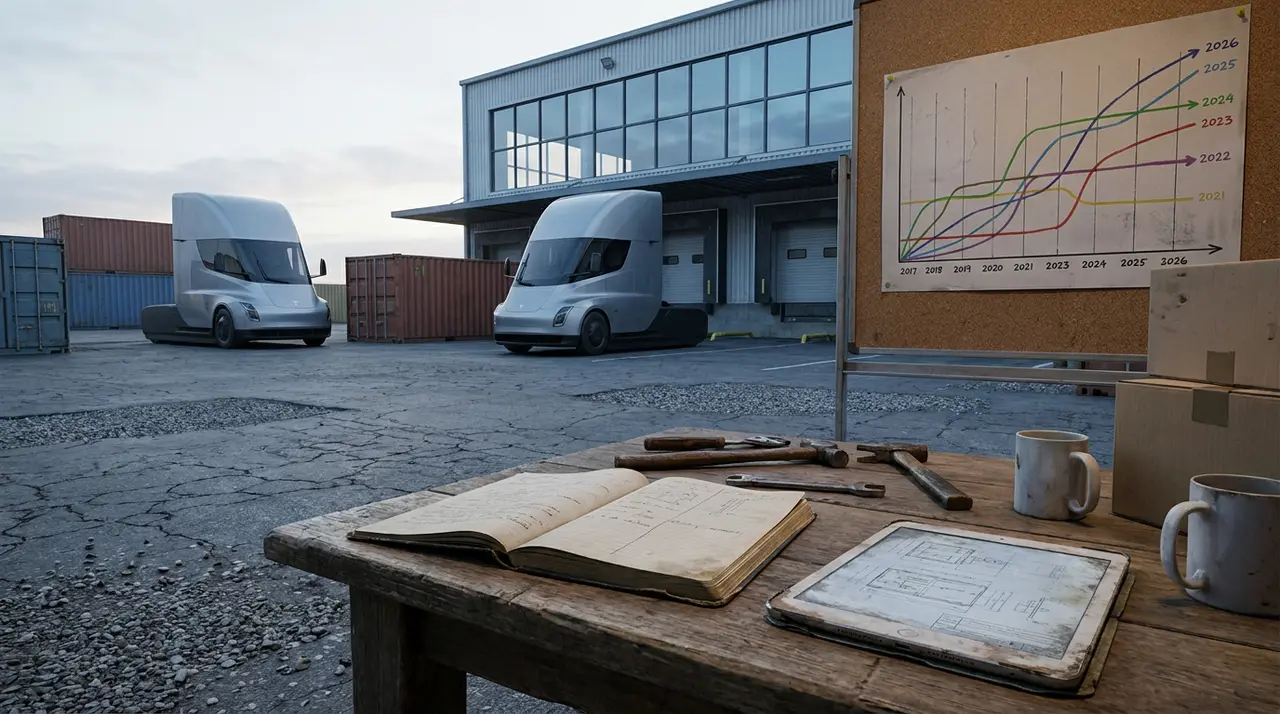
The Tesla Semi shows how launch language and delivery reality can drift apart over nine years. Tesla unveiled the truck in 2017 with production slated for 2019, delivered the first trucks to PepsiCo on December 1, 2022, and in September 2026 declared high-volume production while, according to reports, not disclosing price, production rate or a delivery target. This timeline lines up each claim against what sources reported.
Updated October 18, 2026.
This post is about fleet-facing communications, meaning how a vehicle maker talks to the logistics and freight buyers who must plan around its promises. It is not a review of the truck. Every date and figure below carries its source, and company claims are labeled as company claims.
What did Tesla promise about the Semi, and when?
Tesla promised in 2017 that Semi production would begin in 2019. A Reuters report, as carried by BusinessDay, said the Semi was first unveiled in 2017 and production was expected to start in 2019. FreightWaves reported that the program then suffered repeated delays, including the departure of a key executive and supply chain issues, and that the 2017 prices were $150,000 for the 300-mile version and $180,000 for the 500-mile version.
The volume ambition was larger still. The Drive noted that in 2018 Musk said Tesla would aim to deliver 100,000 Semis by the end of 2023. That is a stated aim, not a commitment, but it set a scale against which later numbers would be read.
What happened between the first delivery and volume production?
Between December 2022 and 2026, the Semi moved from a first delivery to a limited pilot and then to a dedicated factory. The sequence below uses reporting for each step.
-
August 2022: Tesla closed the Semi order book on its website after taking $20,000 deposits for a few months, per FreightWaves.
-
October 6, 2022: Musk said on Twitter that Semi production had started and PepsiCo would receive deliveries on December 1, with a 500-mile range, per FreightWaves. A PepsiCo spokesperson confirmed the date and named its Frito-Lay plant in Modesto and a beverage plant in Sacramento, per FoodBev.
-
December 1, 2022: Tesla delivered its first production Semi to PepsiCo at an event at its Nevada Gigafactory, per Engadget. Tesla posted the next day that the Semi had driven 500 miles fully loaded on a single charge, and PepsiCo had ordered 100 trucks in total.
-
December 2022 to the first quarter of 2024: fewer than 150 units were produced, PepsiCo was the only outside customer to take delivery, and 34 of its 100 orders had been fulfilled, according to InsideEVs reporting from the ACT Expo. Tesla said it was aiming for volume production in 2026 and up to 50,000 trucks a year.
-
April 2026: the first truck came off the new high-volume production line, per Carscoops.
-
July 2026: Tesla's shareholder letter described Semi production as beginning in 2026 and dropped an earlier forecast of volume production that year, per Reuters via BusinessDay.
One source error is instructive. FoodBev quoted a delivery date of "1 December 2023" in one line and 2022 in another, which shows how a single mistyped year can spread when outlets syndicate each other. PepsiCo's own statement said December 1, 2022.
How did Tesla describe the September 2026 launch?
Tesla described the September 24, 2026 event at its Sparks, Nevada plant as the launch of high-volume production, and said deliveries were starting. Reuters, via BusinessDay, reported that customers including PepsiCo, DHL and US Foods were invited on stage, with trucks wearing their logos outside, and that Tesla reiterated plans to build 50,000 Semis a year at the plant.
The product detail was specific. Drive Tesla Canada reported a 1.8 million square foot factory with a Standard Range Semi estimated at 325 miles and a Long Range version at 500 miles fully loaded, with both sharing one assembly line. Runtime Wire noted that Tesla's range and energy-use figures are company estimates, not independently reported fleet results.
Orders were part of the story. Reuters reported that a coalition of large cargo-owning shippers including Microsoft and PepsiCo placed an order for 2,500 Semis that week, according to the nonprofit Catalyst Mobility, which it said was nearly double the existing US fleet of electric Class 8 trucks, and that Einride had announced a deal for 500 trucks.
What did reporters say Tesla did not disclose?
Reporters said Tesla did not disclose a price, a current production rate or a delivery target for the year. Carscoops headlined its report that Tesla started new Semi deliveries "but won't say how many," and Reuters, via BusinessDay, likewise noted that Tesla did not disclose production volume plans or pricing at the event.
Runtime Wire framed the gap this way: the company has not said how many trucks the line is producing now, so the ramp and fleet performance are the real test. The factory's scale was clearer than its present throughput.
There was also a vocabulary issue. Tesla's July update separated production beginning from volume production and dropped the volume forecast for the year, and the September event then used the phrase high-volume production for the launch. Reuters and Carscoops both noted that earlier forecast change. A reader had to reconcile the two statements without a stated production rate.
How do the claims and deliveries line up?
The claims and deliveries line up well on dates for the early milestones and poorly on volume. The list below pairs each claim with what the cited sources report.
-
Claim: production in 2019. Reported: first customer delivery on December 1, 2022, about three years later, per Reuters and Engadget.
-
Claim: 100,000 trucks by the end of 2023 (a 2018 aim). Reported: fewer than 150 produced between December 2022 and the first quarter of 2024, per InsideEVs.
-
Claim: 100 trucks for PepsiCo. Reported: 34 fulfilled by the time InsideEVs reported, with 50 more announced for PepsiCo's fleet.
-
Claim: volume production in 2026. Reported: the first truck off the high-volume line in April 2026, the forecast for volume production dropped in July, and a "high-volume production" launch declared in September with no rate disclosed.
-
Claim: 500-mile range fully loaded. Reported: Tesla's own estimate, with fleet-wide independent results not yet reported, per Runtime Wire.
In Virgo's read, the early pattern is one many hardware launches share: the date slips and the volume lags the aim. What stands out is how the later communications handled terms. When a milestone label is reused with a different meaning, buyers lose the ability to plan around it.
What can a fleet technology brand learn from the Semi rollout?
A fleet technology brand can learn to define each milestone once, publish the number that backs it, and never reuse the label for something smaller. The same lesson appears in our look at fleet electrification PR, where the strongest announcements stated targets, first units and caveats together.
Four habits follow from the Semi record:
-
Separate the milestones. Production start, first delivery and volume production are three different claims, so name each one and date it.
-
Publish the rate. A stated production figure, even a modest one, gives buyers and editors something to plan around and prevents "won't say how many" headlines.
-
Label estimates as estimates. Range and energy-use figures are company estimates until fleet results confirm them, and coverage will say so.
-
Put customers on the record. The September event named PepsiCo, DHL and US Foods on stage, which tied claims to buyers who could be asked about them.
For related cases, see our analysis of EV recall communications and our guide to EV and mobility PR. This post is part of Virgo's physical economy PR guide, which maps the patterns across 19 cases.
Frequently asked questions
When did the Tesla Semi first deliver to a customer?
December 1, 2022, to PepsiCo at Tesla's Nevada Gigafactory, according to Engadget and PepsiCo's own statement quoted by FoodBev.
What did Tesla say at its September 2026 Semi event?
That high-volume production had started at its Sparks, Nevada plant, that deliveries were beginning, and that the plant is meant to build 50,000 trucks a year, per Reuters. Reports said no price, production rate or delivery target was given.
Why does the difference between production and volume production matter?
Fleet buyers plan around delivery dates and quantities. Reuters noted that Tesla's July update dropped its forecast of volume production for 2026, so the label meant different things at different times.
Are Tesla's Semi range figures independently verified?
Runtime Wire described the range and energy-use figures as company estimates, not independently reported fleet results.
What should a fleet technology company disclose at launch?
The milestone being claimed, its date, a production or delivery figure, and which numbers are estimates. These are the elements the Semi coverage said were missing.
Follow us