Expertise · October 16, 2026
Autonomous Trucking Safety Messaging Lessons
By Kyle Porter, Executive Vice President & Managing Director.
Updated October 21, 2026
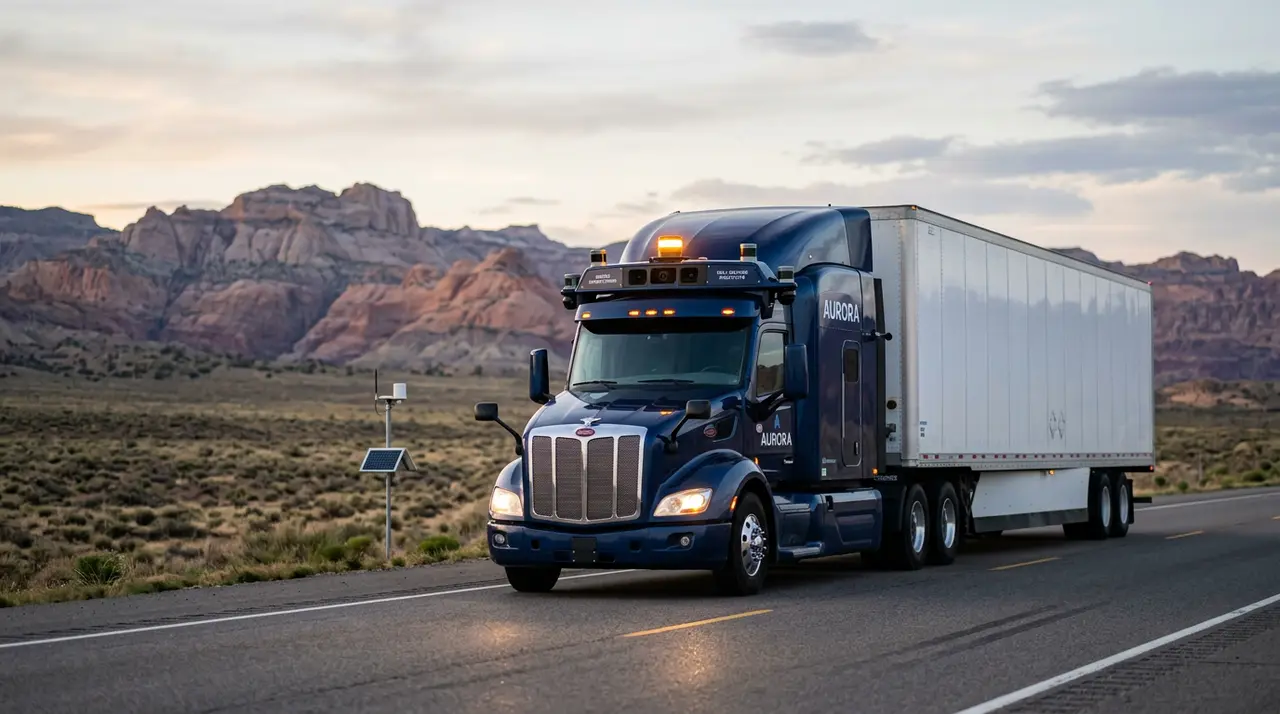
Autonomous trucking safety messaging works when a company states exactly what its system does, publishes the evidence behind it, and says plainly when a partner or regulator requires something more. Aurora Innovation's 2025 to 2026 record shows all three: a safety case shared with regulators before launch, a direct explanation when an observer returned to the cab, and a five-year federal beacon exemption won in October 2026.
Aurora launched a commercial driverless service between Dallas and Houston on May 1, 2025, with Uber Freight and Hirschbach Motor Lines as customers, according to Trucking Dive. In its second quarter 2026 shareholder letter, filed with the SEC on July 29, 2026, the company reported nearly 440,000 driverless miles through June 30, 2026, with 100% on-time performance and zero Aurora Driver-attributed collisions.
What did Aurora publish before its first driverless run?
Aurora published a formal safety case and a public safety report before it removed the human driver from the cab. Transport Topics described the safety case as a structured body of evidence showing the system is acceptably safe to deploy, and reported that it was shared with the Federal Motor Carrier Safety Administration, the National Highway Traffic Safety Administration and multiple Texas agencies. The company also issued a public Driverless Safety Report covering cybersecurity, remote assistance and operational limits.
The evidence came with counts. Chris Urmson, Aurora's co-founder and chief executive, later cited nearly 10,000 requirements and 2.7 million tests behind the safety case, along with more than 6,000 driverless miles on the Dallas to Houston launch lane at that point, according to a company blog post reported by Dallas Innovates.
Two choices stand out. The audience order was regulators first and the public second, which meant the people able to object had seen the material before the first truck rolled. The evidence was also countable, so a reporter could repeat a number instead of an adjective.
How did Aurora explain putting an observer back in the cab?
Aurora explained the change by separating what the truck does from what its partner required. Less than three weeks after the May 2025 launch, Urmson said in a blog post that PACCAR, the maker of the Peterbilt and Kenworth trucks, had requested a person in the driver's seat because of certain prototype parts in the base vehicle platform, according to Axios and Trucking Dive.
The same post made three points in plain terms. Urmson said the company was confident the change was not required to operate the truck safely. He said the observer would not operate the vehicle, and that the Aurora Driver would remain fully responsible for all driving tasks, including pulling over to a safe location if needed. He also said the change did not affect Aurora's near, mid or long term plans. Axios added that observers had already been riding in the back of the cab on trips expected to meet bad weather.
The message did not control the headlines. Dallas Innovates led with "Aurora Puts 'Observers' Back Behind Wheel," and Axios wrote that the trucks had a human observer behind the wheel again. Ceren Wende, a Volvo spokesperson, told Axios that Volvo would remove the safety driver on its own trucks only after thoroughly evaluating all factors, a more conservative stance that framed Aurora's decision by contrast.
The lesson is that a clear explanation limits damage but cannot stop a simple headline. The explanation worked best as a reference for reporters, because it stated who asked, why, and what the human would not do.
What did the warning beacon fight show about regulator messaging?
The beacon fight showed that a company can keep making a specific technical case over two years while operating within the rules it disputes. Federal rules require a driver to place warning devices around a commercial truck that stops on a highway. In December 2024, the FMCSA denied Aurora's request for an exemption, and Aurora said it would use cab-mounted warning beacons instead and filed a lawsuit, according to Land Line.
In January 2025, Ossa Fisher, Aurora's president, wrote in a blog post that the denial would not stop the company from complying with the existing rule at launch, according to the same report. Aurora also said its process for placing warning triangles had been tested before its commercial launch. The FMCSA later issued a temporary waiver effective October 10, 2025, according to Runtime Wire.
The Transportation Department approved a five-year exemption on October 7, 2026, and Reuters reported it the next day, according to Runtime Wire. The Trucker reported that the exemption lets qualifying autonomous trucks use flashing amber beacons mounted high on the cab, with restrictions on eligible vehicles and reporting requirements for monitoring.
The Owner-Operator Independent Drivers Association objected throughout, according to TruckDriversUS, raising scenarios such as a truck parked within 500 feet of a curve and a beacon that loses power. A summary of the Federal Register decision by the analysis blog Pebblous reported that during the waiver period 34 trucks covered more than 500,000 miles with no beacon defects, and that the beacons were lit for less than ten hours in total.
The opponent's objections were specific, and the eventual answer was specific too: data from a defined fleet over a defined period. A general assurance would not have answered a question about a curve.
How did Aurora keep its safety claim consistent as scale grew?
Aurora kept the same narrow claim in every update while the numbers grew. In January 2026, Urmson cited 250,000 driverless miles with no collisions attributed to the Aurora Driver, according to TruckDriversUS. In the July 29, 2026 shareholder letter, the figure was nearly 440,000 miles with zero Aurora Driver-attributed collisions and 100% on-time performance.
The wording is precise, and it invites a follow-up. "Aurora Driver-attributed" covers collisions the company attributes to its own software, not every incident involving one of its trucks. A reporter can fairly ask who makes the attribution, so the sentence is stronger when it defines the term and states the method.
The same letter reported another milestone. Aurora said it had launched a new fleet of driverless trucks based on the International LT series without a person behind the wheel, and that it was fully allocated to exit 2026 with 200 driverless trucks in operation. The company's first quarter 2026 release had said that observer-free launch was on track for the second quarter, and the July 29 letter described the launch as having happened the week before. A launch a few weeks past the named quarter is a small miss, but it shows why a date should be stated with the day it was reached. The TradingView summary of the letter also listed independent audits by TÜV SÜD of Aurora's organization and of its edge case safety case.
What can other autonomous fleets copy from Aurora?
Other autonomous fleets can copy five habits, and the table below shows where each came from.
MomentDateWhat Aurora saidWhat it committed to
Commercial launchMay 1, 2025Safety case shared with FMCSA, NHTSA and Texas agencies, public Driverless Safety ReportNearly 10,000 requirements and 2.7 million tests behind the case Observer changeMay 2025PACCAR requested it, not required for safety, observer does not operatePlans unchanged Beacon exemptionOctober 7, 2026Five-year exemption after a December 2024 denial and an October 2025 waiverOperating restrictions and reporting requirements Scale claimJuly 29, 2026Nearly 440,000 driverless miles, zero Aurora Driver-attributed collisions200 driverless trucks in operation by year end
-
Describe the safety evidence in countable terms, such as requirements, tests and miles, so a reporter can repeat a number.
-
Share the safety case with regulators before launch, and publish a public version for everyone else.
-
When a partner changes the setup, say who asked, why, and what the human in the cab does not do.
-
Define every narrow claim in the same sentence, such as what "attributed" means and who decides.
-
Answer an opponent's specific scenarios with data from a named fleet and period, not with an assurance.
The same habit of leading with checkable facts shows up in tariff communications for logistics and in data center power PR, and the physical economy PR guide shows where this post fits in the series.
Across two years, the thread in Aurora's communications was that every claim had an owner and a number attached. A competitor can match the technology, but the discipline of stating what the system does, what the evidence is and what a partner required is the part that is easiest to copy and hardest to fake.
Follow us