
Expertise · October 11, 2026
Fleet Electrification PR: Lessons From 3 EV Rollouts
By Virgo PR Editorial
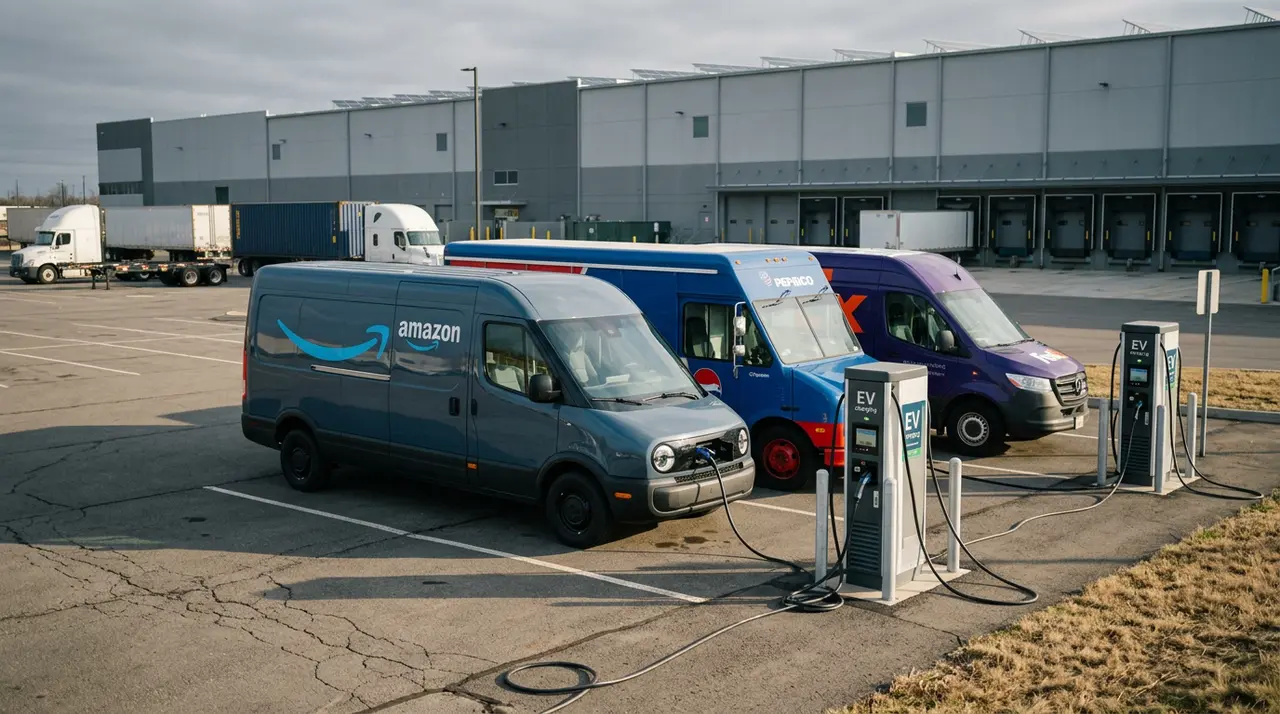
Fleet electrification PR earns coverage when an announcement states a target, the first units delivered and the caveats on range and charging. FedEx said on December 17, 2021, that it had received the first five of an order of 500 BrightDrop EV600 vans, with an estimated range of up to 250 miles, per its newsroom release. Three rollouts from Amazon, PepsiCo and FedEx show how each handled the gap between promise and delivery.
This is the sixth piece in Virgo's logistics PR series. It extends Virgo's earlier electric vehicle coverage, including the role of PR in shaping the future of the electric vehicle industry, from consumer vehicles to commercial fleets.
What does fleet electrification PR have to prove?
Fleet electrification PR has to prove that a vehicle works on a real route, with real charging and on a real schedule. A fleet buyer reads an announcement for range, charging and delivery dates, so each unverified claim becomes a question for the operator.
The three cases below differ in who spoke first. Amazon announced a pledge, PepsiCo's supplier announced a vehicle, and FedEx announced a delivery. Each approach left a different gap between the claim and the record.
How did Amazon announce 100,000 electric vans?
Amazon announced the order at the National Press Club on September 19, 2019, when Jeff Bezos said the company had ordered 100,000 electric delivery vans from Rivian as part of its Climate Pledge, according to Click On Detroit. Fleet News reported the plan: first vans in 2021, 10,000 on the road as early as 2022 and all 100,000 by 2030, saving four million metric tons of carbon a year by 2030.
Bezos framed the move as a break from the pack, saying Amazon was "done being in the middle of the herd" on the issue, per Fleet News. Amazon also tied the order to a net-zero carbon goal for 2040 and to a $700 million investment round it led in Rivian in 2019, according to The Driven.
The delivery record came later. CNBC reported on July 21, 2022, that Amazon was starting to roll out the vans and expected thousands in more than 100 cities by the end of the year, while Rivian had cut its 2022 production forecast in half to 25,000 vehicles including Amazon's. Trade and Industry Development reported in November 2022 that more than 1,000 vans were delivering in more than 100 US cities and had delivered over 5 million packages.
Why it works: The pledge gave Amazon a single large number and a date that editors could hold it to. In Virgo's read, the later updates with named counts and package totals rebuilt trust because they reported what had happened, not what was planned.
Copy this: Pair a large pledge with an interim target you can beat, and report the delivered count each time you update.
How did PepsiCo handle the Tesla Semi delivery?
PepsiCo confirmed on October 7, 2022, that it would take its first Tesla Semi trucks on December 1, for use at its Frito-Lay plant in Modesto and its beverages plant in Sacramento, according to Reuters via Euronews. PepsiCo had ordered 100 trucks in 2017, and Reuters noted that Elon Musk had first promised production by 2019.
PepsiCo kept the numbers small. AFP reported that a PepsiCo spokeswoman declined to say how many trucks would arrive and said more details would follow once PepsiCo had taken delivery. Reuters added that PepsiCo's website expected 15 trucks by the end of the year.
The operator's later figures differed from the manufacturer's headline. InsideEVs reported that PepsiCo vice president Mike O'Connell planned 15 trucks in Modesto and 21 in Sacramento, with initial trips of about 425 miles for snacks and about 100 miles for heavier beverage loads. The same report cites a $15.4 million state grant and a $40,000 federal subsidy per vehicle. A PepsiCo manufacturing executive said the trucks had a range of around 400 miles, while Tesla cites 500 miles, per another InsideEVs report.
Why it works: In Virgo's read, PepsiCo let the customer control the news, so the date and the sites came from the buyer and not the seller. The operator's own range and route figures were more useful to fleet buyers than the manufacturer's best case.
Copy this: Let the fleet operator announce the delivery date, and publish the operator's measured range and route lengths beside the manufacturer's specification.
How did FedEx announce its first BrightDrop vans?
FedEx announced a first delivery of five vans out of 500 ordered, which made the small first step the headline. The FedEx release said the first five EV600s went to the FedEx Express facility in Inglewood, California, and that FedEx aims for an all-electric, zero-emission global pickup and delivery fleet by 2040.
The release attached an infrastructure number, saying FedEx had already installed 500 charging stations across California. FedEx's chief sustainability officer Mitch Jackson and BrightDrop CEO Travis Katz were both quoted, per FreightWaves. Fleet Owner reported that FedEx was the first customer to receive the EV600 and that BrightDrop called it the fastest vehicle GM had taken from concept to market.
Why it works: The release labels the 250-mile range as an estimate and states the first delivery as five units. In Virgo's read, a small honest first count makes a later count less likely to read as a miss, and the charging figure answers the first question a fleet manager would ask.
Copy this: Announce the first units at their true size, label every range figure as an estimate, and state the charging infrastructure already in place.
What did the three rollouts have in common?
The three rollouts shared a stated target, a named executive and a headline count, and they differed in how much of the caveat they disclosed. The table below compares them.
RolloutDateHeadline numberNamed voicesCaveat disclosed
Amazon and RivianSeptember 2019100,000 vans by 2030Jeff BezosFirst vans planned for 2021, 10,000 by 2022 PepsiCo and Tesla SemiOctober 2022100 trucks ordered, 15 expected by year endPepsiCo spokeswoman, Mike O'ConnellSpokeswoman withheld the delivery count FedEx and BrightDropDecember 17, 2021First 5 of 500 vans, up to 250 milesMitch Jackson, Travis KatzRange labeled an estimate
Where did the reported claims and figures differ?
Reported claims and figures differed in four places, and each gap is a question an editor can ask. Amazon's 2019 plan, per Fleet News, called for 10,000 vans as early as 2022, while Trade and Industry Development reported more than 1,000 vans in November 2022. The reports do not say whether Amazon revised the target.
Tesla cites a 500-mile range for the Semi, while PepsiCo's executive said around 400 miles, per InsideEVs. The PepsiCo grant appears as a $15.4 million state grant in one InsideEVs report and as $15 million in state and local grants, including charging infrastructure, in the Sacramento report. FedEx's release is dated December 17, 2021, while a Benzinga contributor piece gives December 20 and Fleet Owner is dated December 21.
In Virgo's read, a fleet brand cannot stop outlets from mixing figures, but it can publish one dated page with every number, its source and its status, so the next reporter starts from the correct version.
How should a fleet electrification announcement be written?
A fleet electrification announcement should include six elements that the three rollouts used in part. The table below lists each element and the case that shows it.
ElementWhat to stateExample
Target and dateThe fleet goal and its deadlineFedEx: all-electric pickup and delivery fleet by 2040 First unitsHow many were delivered, and whereFedEx: first 5 of 500, Inglewood Operator-measured rangeRange and route length from real use, with the manufacturer's figure labeledPepsiCo: about 400 miles versus Tesla's 500 InfrastructureChargers installed and whereFedEx: 500 charging stations in California IncentivesGrants and subsidies that offset costPepsiCo: $15.4 million state grant, $40,000 federal per vehicle Delay historyWhat slipped and the new dateTesla Semi: promised for 2019, delivered December 2022
What should a fleet electrification brand do first?
A fleet electrification brand should publish the delivered count and the operator's measured range before it announces the next target. Start with one page that lists every figure, its date and its source.
Then match the announcement to the asset. A brand with a pledge can follow Amazon, a brand with a customer can follow PepsiCo, and a brand with a first delivery can follow FedEx. The sustainability proof points in Virgo's industrial sustainability PR lessons apply to the target, and the unit-and-condition format in the warehouse robotics PR analysis applies to the announcement. Virgo's earlier posts on climate tech PR for electric vehicles and on targeting consumers as electric vehicle sales slow cover the consumer side.
This post is part of Virgo's Physical Economy PR guide, which maps all seven posts in the series and the patterns across 19 cases.
Follow us