Expertise · October 18, 2026
Warehouse Automation PR: 3 Cases and What They Teach
By Kyle Porter, Executive Vice President & Managing Director.
Updated October 21, 2026
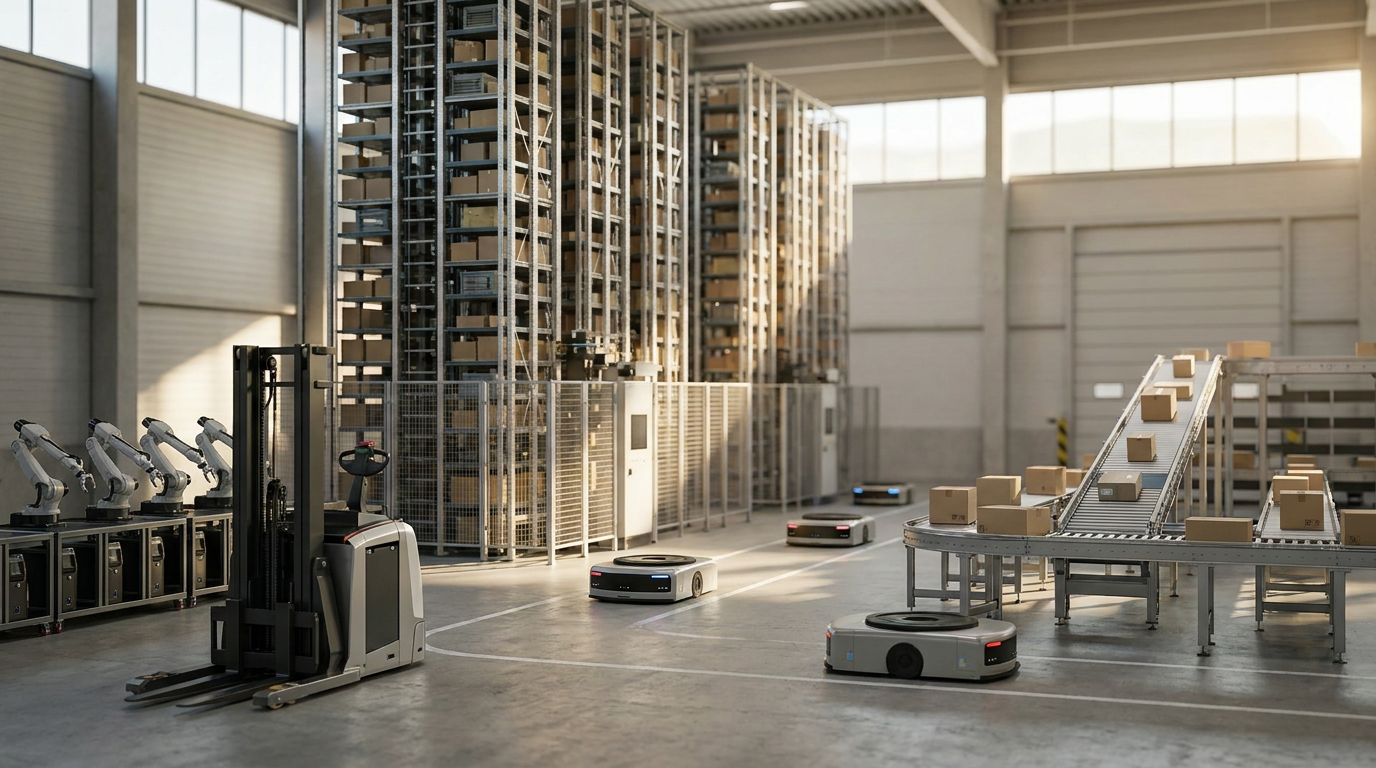
Warehouse automation PR works when an announcement names its customer, states its counts and sticks to claims the company can back later. A GXO and Agility Robotics humanoid deal named a facility and a deployment model, Locus Robotics turned a pick counter into a six-year news cadence, and Kroger's closure of three Ocado fulfillment centers shows what happens when a large commitment meets reality. Each case below names its mechanism and what an automation brand can copy.
Updated October 18, 2026.
None of the sources below say a PR team planned these moves, so treat them as repeatable mechanisms, not agency case studies. We started from a longer list and kept only the cases we could source.
How were these three warehouse automation cases chosen?
Virgo chose three warehouse automation cases that a company release or a major outlet documents and that carry figures a reporter can check. Moves supported only by social posts or unnamed sources were left out, because an editor cannot verify them.
The selection is a judgment, not a ranking, and it deliberately includes one cautionary case. Announcement strategy is easier to judge when you can see both a launch that held up and a partnership that was later scaled back. For earlier cases from DHL, Amazon and Symbotic, see our look at warehouse robotics PR announcements that won press.
How did GXO and Agility Robotics announce a humanoid deployment?
GXO and Agility Robotics announced on June 27, 2024 that they had signed a multi-year agreement to begin deploying Agility's Digit humanoid robot in GXO's logistics operations, according to the GXO news release. The release said the agreement followed a proof-of-concept pilot in late 2023 and was the industry's first formal commercial deployment of humanoid robots and first Robots-as-a-Service deployment of humanoid robots.
Trade coverage added the specifics. Modern Materials Handling reported that the pilot took place at a GXO site near Atlanta that provides fulfillment services for the apparel brand SPANX, and that Digit integrates with existing automation, including autonomous mobile robots. Robotics 24/7 carried the same announcement.
Note how the coverage handled the headline claim. Modern Materials Handling attributed the "first" label to Agility Robotics, and Agility's chief executive said in the release that the company was the first with humanoid robots deployed at a customer site and generating revenue. A "first" is the claimant's statement until someone else verifies it.
Why it works: In Virgo's read, naming the customer site, the pilot that came before and the commercial model gave editors a path from experiment to contract, and attributing the "first" to the company kept the claim accurate.
Copy this: Announce a deployment with the customer site, the pilot history and the commercial model, and let the company, not the editor, own any "first" claim.
How did Locus Robotics turn a pick counter into a news cadence?
Locus Robotics turned a running count of units picked into a recurring announcement. Its April 24, 2025 release said it had passed 5 billion picks across customer deployments, 24 weeks after reaching 4 billion in October 2024, and listed every earlier milestone: 1 billion in September 2022, 2 billion in August 2023, 3 billion in April 2024 and 4 billion in October 2024, per Robotics 24/7.
The cadence continued. A later Robotics 24/7 report said Locus passed 6 billion picks in October 2025, again 24 weeks after the previous billion, and quoted a project lead at a customer site, The Quality Group's Elsdorf location. The company's October 2025 Business Wire release added that Locus was on track for 60 million picks a week during the fourth-quarter peak.
The number is the company's own. It counts picks across customer deployments, and the sources report it as a company metric. That makes it a good news hook and a limited proof point.
Why it works: In Virgo's read, a fixed counter and a published history table turn each milestone into a trend line, and the shrinking gap between milestones is itself the story. Naming customers in the release gives the figure a human voice.
Copy this: Pick one count you can measure the same way every time, publish the full milestone history in each release, and quote a named customer.
What did Kroger's Ocado closures show about announcement risk?
Kroger's closure of three Ocado-powered fulfillment centers showed that a large commitment becomes the yardstick for everything that follows. Kroger partnered with Ocado in 2018 to build automated grocery fulfillment centers and had planned about 20 of them, according to Automated Warehouse.
On November 18, 2025, Kroger said it would close three of its automated fulfillment centers and monitor the five remaining ones, with a $2.6 billion charge in its fiscal third quarter, according to an Associated Press report. Ocado's shares fell 16 percent that day. Shares Magazine reported that Ocado named the closed sites as Frederick, Pleasant Prairie and Groveland, expected compensation of more than $250 million, and said the closures would cut its fee revenue by about $50 million in its 2026 financial year.
Both companies framed the news carefully. Kroger described a comprehensive review to optimize its network, and Ocado said it continued to support Kroger and expected significant growth in the US market. ESM Magazine reported that Kroger would lean more on delivery partners, and noted analyst reaction that was far less forgiving.
Reported figures differed. The Automated Warehouse headline put the payment at $350 million, while Ocado's own statement, as reported by Shares Magazine, said more than $250 million. A reader should check which figure refers to compensation and which to fees before repeating either.
Why it matters: In Virgo's read, a headline target of 20 centers set the scorecard, and every later change was reported against it. A first-phase commitment with a stated review point gives a company room to adjust without the change reading as a retreat.
Copy this: Announce the first phase and the date of the review, not only the total ambition, and keep the language of any later change as specific as the original claim.
What evidence backs each of the three cases?
Each case rests on a company release or a major outlet that names its figures. The list below shows the key figure, the evidence and the source type, so a reader can check each one.
-
GXO and Agility Robotics (June 2024): a multi-year agreement following a late 2023 pilot, described as the first formal commercial humanoid deployment by Agility. Evidence: the GXO release, Modern Materials Handling and Robotics 24/7. Source type: company release and trade reporting.
-
Locus Robotics (2022 to 2025): 1 billion picks in September 2022 to 6 billion in October 2025, with the last two billions each taking 24 weeks. Evidence: Robotics 24/7 and a Business Wire release. Source type: company metric reported by trade media.
-
Kroger and Ocado (November 2025): three centers closed, five kept, a $2.6 billion charge, Ocado shares down 16 percent. Evidence: an Associated Press report, Shares Magazine and ESM Magazine. Source type: wire and trade reporting.
In Virgo's read, the Locus case shows the cheapest route for an automation brand: a counter the company controls, published on a schedule, with a customer quote. No editor has to be persuaded to attend an event.
A claim without a document gives an editor nothing to verify. A customer result with no named customer, for example, cannot be checked, so it rarely supports a news story on its own.
Which mechanism fits your automation brand?
The three mechanisms differ in the asset a brand must own before it can use them. The list below pairs each mechanism with that asset, based on Virgo's assessment of the three examples.
-
GXO and Agility, named deployment: a signed customer, a pilot history and a deployment model. Best fit: robotics vendors with a real customer.
-
Locus, milestone cadence: a count you can measure consistently and permission to name customers. Best fit: vendors with fleet-scale data.
-
Kroger and Ocado, the cautionary case: a large partnership announced with a total target. Best fit as a warning for any vendor or retailer planning a multi-year rollout announcement.
What should a warehouse automation brand do first?
A warehouse automation brand should list the assets it already owns, such as a customer, a counter and a phased plan, and match each to the list above. Start with the customer, because a named site is the strongest proof a trade editor can use.
Then choose the one count you can publish on a schedule and write down how it is measured. Decide in advance how you will announce a change to any plan, because the first announcement sets the yardstick.
The neighboring freight lane follows the same logic in our roundup of logistics PR campaigns and our guide to the logistics trade press. Manufacturers use the same mechanisms, as in our look at manufacturing PR campaigns. This post is part of Virgo's physical economy PR guide, which maps the patterns across 19 cases.
Frequently asked questions
What makes an automation announcement earn coverage?
A named customer, a counted result and a clear commercial model. The three cases above each gave editors a figure and a source they could check.
Can a company call a deployment the first of its kind?
Only as its own claim. In the GXO and Agility case, trade coverage attributed the "first" label to Agility, which is the accurate way to carry a claim nobody has independently verified.
Why do milestone announcements work for automation vendors?
A fixed counter creates a news hook on a schedule. Locus published its milestone history in each release, so every new billion read as a trend line.
What does the Kroger closure teach about announcements?
That a large total target becomes the scorecard. Announcing a first phase and a review point leaves room to adjust without the change being read as a retreat.
Do automation announcements need a big budget?
No. Locus used its own releases and a counter it controls, and the mechanism was the cadence, not the spend.
Follow us